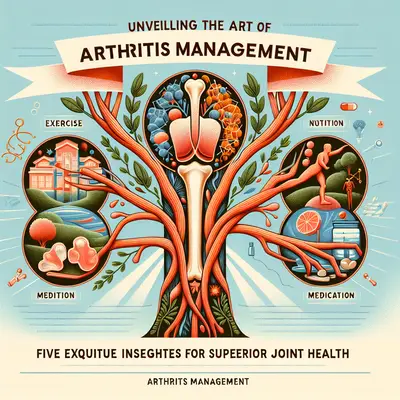
Arthritis management is often framed in terms of damage control—pain relief, flare avoidance, and “getting through” the day. Yet for those who value discernment in every area of life, there is a more nuanced path. Arthritis care can evolve from a checklist of medical tasks into a deliberate craft: one in which you refine inputs, curate your environment, and attend to details that most people overlook. This is not about perfection; it is about precision—subtle, strategic choices that quietly transform how your joints age and how you inhabit your body.
Below are five exclusive, elevated insights tailored to those who treat joint health as a long-term, high-value investment rather than a short-term fix.
Insight 1: Treat Your Anti-Inflammatory Strategy Like a Portfolio, Not a Single Bet
Most people rely on one dominant lever for arthritis—usually medication or exercise—and hope for the best. A more sophisticated approach treats inflammation management as a diversified portfolio: multiple small, evidence-based levers that compound over time.
That means understanding that NSAIDs, biologics, or DMARDs are only one “asset class.” Others include loading patterns (how your joints experience force), sleep quality, glycemic stability (blood sugar swings silently fuel inflammation), and micro-nutrition (omega-3s, vitamin D, and polyphenols). The goal is not to find one miracle intervention, but to cultivate a measured synergy among many.
Think of your life in terms of inflammatory “exposure.” Extended sitting with poor posture, repeated late nights, ultra-processed food, and unmanaged stress are each modest inputs—but together, they create a pro-inflammatory climate around your joints. Conversely, a thoughtfully composed plate, a predictable sleep window, low-impact strength training, intelligent movement breaks, and stress modulation create the opposite climate. The elegance lies in the balance: no single habit needs to be extreme if the overall portfolio is carefully calibrated.
Insight 2: Load Is a Luxury Variable—Not Just Weight on a Scale
For joint-conscious individuals, “weight loss” is frequently recommended, but often handled in a blunt way. A more refined lens is to think in terms of load intelligence rather than just body weight. Load is not only what the scale shows—it is how force is transmitted through your joints over thousands of micro-movements each day.
The same body weight can be either harsh or gentle on your joints depending on footwear, surface type, joint alignment, and muscle support. A curated environment—supportive shoes, cushioned flooring in the areas where you stand longest, careful selection of chairs and workstations—can make the same daily activities substantially less abusive to cartilage and ligaments.
Strength training becomes less about aesthetics and more about architectural support. Strong hips quiet an overworked knee. A stable core offloads the lumbar spine. Targeted strengthening around arthritic joints improves force distribution so that each step, reach, or lift becomes a little more refined in its impact. In this lens, every deliberate muscle you build is a luxury cushion for your joints—an internal, living “orthotic” system you can’t buy off the shelf.
Insight 3: Precision Motion: Curating a Personal “Joint Movement Signature”
Most arthritis advice stops at “stay active” or “move more.” This is far too crude for someone who values longevity and nuance. Your joints deserve a curated movement signature: a personally tailored repertoire of motions that nourish cartilage, preserve range, and respect your particular diagnosis.
Cartilage is not fed by blood vessels; it is nourished by the ebb and flow of synovial fluid triggered by movement. The right kind of motion is like artisan care for your joint surfaces: smooth, controlled, multi-directional, and performed regularly rather than sporadically heroic. This rarely looks like random stretching; it looks like deliberately exploring full but comfortable ranges, under light load, at varied speeds.
This is where working with a skilled physical therapist or movement specialist becomes invaluable, not just to “rehab” but to design. You are not merely fixing what is wrong; you are crafting a sustainable and elegant way of moving. Over time, this becomes as personal and recognizable as your handwriting—your own movement signature that conserves energy, respects vulnerable structures, and keeps you feeling agile well into later decades.
Insight 4: Pain Data as a Luxury Feedback System—Not an Enemy
For many, pain is an adversary to be silenced. Those with a more cultivated approach treat pain as high-value data. Pain patterns, timing, and triggers reveal how your joints are responding in real time. Instead of chasing relief in isolation, you can use pain as a guidance system to refine your routines, therapies, and expectations.
This means moving beyond simple “0–10” scores and noticing qualitative dimensions of pain: sharp versus dull, surface versus deep, local versus diffuse, mechanical (related to use) versus inflammatory (morning stiffness, night pain). Keeping a concise, structured record—what you did that day, sleep quality, stress level, specific movements—can reveal subtle correlations you might otherwise miss.
Over time, this log becomes a sophisticated feedback loop. You may find, for example, that high-sodium restaurant meals consistently precede next-day stiffness, or that certain late-night screens disturb sleep enough to provoke a flare. This is the art of arthritis: not just reducing pain in the moment, but decoding it so that each flare informs a smarter, more tailored strategy for the months ahead.
Insight 5: Aligning Medical Decisions with Your Long-Term “Joint Identity”
Most discussions about arthritis treatments—medications, injections, surgery—focus on immediate pros and cons. A more elevated framework asks a deeper question: Who do you want to be physically, 10 or 20 years from now—and does your current strategy point in that direction?
This “joint identity” perspective reframes choices about disease-modifying therapies, biologics, or even joint replacement. Instead of asking only, “What are the side effects?” or “How fast will this reduce pain?”, you also consider: Does this option protect joint structure over the long term? Does it allow me to maintain a lifestyle I value—travel, refined hobbies, physical independence? Am I under-treating out of fear or over-treating out of impatience?
Creating this long-term identity is best done in collaboration with a rheumatologist or orthopedic specialist who appreciates nuance. You bring your curated priorities—cognitive clarity, athletic pursuits, aesthetic preferences, risk tolerance—and they bring evidence on disease modification and risk reduction. The result is a treatment architecture that feels not only clinically sound but also personally congruent. Your medications, therapies, and procedures become deliberate investments in the kind of life you want your joints to support.
Conclusion
Arthritis does not need to be the story of decline; it can be the story of refinement. When you treat inflammation as a portfolio to manage, load as a variable to sculpt, movement as a personal signature, pain as information, and treatment choices as expressions of your future identity, your relationship with your joints changes. You move from reacting to arthritis to actively crafting how it intersects with your life.
This is the quiet luxury of advanced arthritis management: not loud interventions or dramatic overnight transformations, but thoughtful iterations that accumulate. Over years, those iterations become visible—in how you walk, how you rise from a chair, how you travel, how you rest. In a world that often accepts stiffness and limitation as inevitable, choosing to cultivate your joints with this level of intention is, in itself, an elegant act.
Sources
- [Centers for Disease Control and Prevention – Arthritis Basics](https://www.cdc.gov/arthritis/basics/index.html) - Overview of arthritis types, symptoms, and general management principles
- [Arthritis Foundation – Treatment Options](https://www.arthritis.org/treatments) - Detailed discussion of medications, therapies, and lifestyle approaches for arthritis care
- [Johns Hopkins Medicine – Osteoarthritis](https://www.hopkinsmedicine.org/health/conditions-and-diseases/osteoarthritis) - Evidence-based explanations of joint load, cartilage health, and treatment strategies
- [Mayo Clinic – Rheumatoid Arthritis](https://www.mayoclinic.org/diseases-conditions/rheumatoid-arthritis/diagnosis-treatment/drc-20353653) - Guidance on disease-modifying therapies and long-term management considerations
- [Harvard Health Publishing – Exercise and Arthritis](https://www.health.harvard.edu/pain/exercise-and-arthritis) - Research-backed insights into movement, strength training, and joint-friendly exercise choices
Key Takeaway
The most important thing to remember from this article is that this information can change how you think about Arthritis Management.