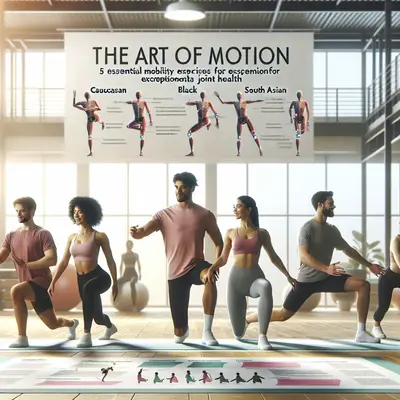
Mobility work is often presented as something you do only when you are injured or “getting older.” At Joint Health Living, we see it differently. Thoughtful mobility training is a daily refinement—a way of moving that preserves the quiet luxury of a body that cooperates. This is not about contortion or extreme stretching; it is about cultivating joints that glide, rotate, and bear load with elegant ease, year after year.
Mobility as Joint Nutrition, Not Just Stretching
Most people equate mobility with stretching, yet joints respond less to how far you reach and more to how consistently you feed them quality movement.
Synovial joints—the knees, hips, shoulders, spine—are nourished by synovial fluid, which circulates best when joints are moved through controlled ranges. Think of mobility drills as “joint nutrition”: each slow rotation or carefully guided bend spreads lubricant across cartilage surfaces, supporting smoother motion and less friction over time.
This means that brief, intentional mobility work peppered throughout the day can be more beneficial than an occasional intense stretch session. A two‑minute neck sequence at your desk, several ankle circles while the kettle boils, or a deliberate hip rotation practice in the evening can cumulatively have a profound effect. The result is less stiffness upon waking, more comfort in transitions (standing, climbing stairs, getting into a car), and a sense that your joints are quietly well cared for, rather than merely “used.”
Exclusive Insight #1: The 3‑Angle Rule for Lasting Joint Comfort
Healthy joints rarely move in a straight line. Yet most “flexibility” routines focus on a single plane: forward and back. The 3‑Angle Rule invites you to approach every major joint from at least three distinct directions in a single session.
For the hip, this might look like:
- A slow controlled march (hip flexion)
- Standing leg swings out to the side (abduction)
- Gentle backward reach (extension), all within a comfortable, pain‑free range
- Forward circles
- Side raises
- Gentle diagonal reaches across the body
For shoulders:
By consistently exploring multiple angles, you invite balanced strength, prevent overuse of a single movement path, and help the nervous system perceive each joint as “safe” in a wide variety of positions. Over time, daily tasks—turning to look behind you, stepping sideways, rotating to reach the back seat—feel smoother because you have trained for them deliberately, not incidentally.
Exclusive Insight #2: Tempo Mobility—Why Slowing Down Protects Cartilage
We tend to move quickly through mobility drills, as though speed equates to effectiveness. For joint health, the opposite is often true. Slower movement (what we might call “tempo mobility”) gives your tissues time to adapt and your brain time to refine control.
When you lift an arm or rotate a knee slowly:
- Muscles must engage more precisely to guide the joint
- The nervous system receives clearer feedback on joint position
- Micro‑instabilities—small “wobbles” or shaky segments—are revealed rather than hidden
These “wobbles” are not flaws; they are invitations. When you feel a point of shakiness in a slow hip circle, reduce the range slightly and move through that zone with patience. Over days and weeks, that once‑unstable angle becomes more secure. You are not merely getting looser—you are building reliable strength through motion, which is ultimately what protects cartilage and ligaments from abrupt, poorly controlled forces.
A refined daily practice: choose one joint (for example, the neck or ankle) and spend 60–90 seconds performing ultra‑slow, smooth circles. Prioritize ease of control over range. You are training your joints to be articulate, not just flexible.
Exclusive Insight #3: Micro‑Load Mobility—Light Resistance as a Joint Shield
Conventional wisdom often suggests that joints in pain should avoid load. Emerging evidence and clinical experience suggest a more nuanced truth: intelligently applied light resistance can be profoundly protective, especially for people concerned about arthritis or joint degeneration.
“Micro‑load mobility” pairs gentle movement with minimal resistance—such as:
- A light resistance band during shoulder rotations
- A small ankle weight for slow, hanging leg raises
- A light dumbbell during controlled wrist circles
The goal is not fatigue; it is refinement. The slight load encourages muscles around the joint to engage just enough to create a supportive “corset,” distributing forces more evenly across joint surfaces.
For a knee‑focused example, a seated leg extension with a very light ankle weight, raised and lowered over 3–5 seconds, can fortify the quadriceps’ capacity to guide the kneecap smoothly. Over time, this can translate to more comfortable stair climbing and less discomfort after long periods of sitting. The key is strict quality control: no jerky motions, no racing, and always within a non‑painful range.
Exclusive Insight #4: The Order of Operations—Sequence Matters More Than You Think
Most people perform mobility work in a random order. However, the sequence in which you approach your joints influences how comfortable and effective your session will be.
A refined order of operations:
Spine first – Gentle cat‑camel, thoracic rotations, or standing side bends
Hips and pelvis – Hip circles, controlled leg swings, pelvic tilts
Shoulders and upper back – Arm circles, scapular glides, chest openers
Knees and ankles – Controlled bends, ankle circles, calf raises
By starting with the spine, you “unlock” the central axis of the body. This allows the hips and shoulders—the major ball‑and‑socket joints—to move with less compensatory tension. Only then do you fine‑tune the more hinge‑like joints (knees, elbows) and the smaller, stabilizing joints (ankles, wrists).
This top‑down (or center‑out) approach creates a smoother felt sense of movement. It can reduce the tug‑of‑war between tight segments and more mobile ones, and it often results in a noticeable reduction in perceived stiffness in fewer minutes. Done regularly, the sequence itself becomes a calming ritual: a predictable, efficient structure that ensures each region receives thoughtful attention.
Exclusive Insight #5: Circadian Mobility—Aligning Movement with Your Body Clock
There is a quiet sophistication in aligning mobility work with your body’s natural rhythms instead of fighting them. Your joints, muscles, and connective tissues do not feel the same at 7 a.m. as they do at 7 p.m., and your approach should reflect this.
Consider a circadian mobility strategy:
- Morning – Gentle, wave‑like motions to “wake” the joints: neck tilts, spinal rolls, ankle circles in bed or while standing by the sink. The emphasis is on warmth and circulation, not depth.
- Midday – Short posture resets: thoracic rotations, chest openers, hip flexor releases after sitting, brief wrist and finger mobility if you type often. Think of these as anti‑sedentary interventions.
- Evening – Slightly deeper, slower mobility: long exhalations paired with hip openers, shoulder rotations against a wall, or gentle spinal twists. This is the time when tissues are warmer and more receptive to gradual lengthening.
By synchronizing the type of mobility you practice with your body clock, you reduce the perception of strain and increase adherence. It feels less like “exercise” and more like a series of thoughtfully timed interludes that support clarity, comfort, and ease of movement across the entire day.
Weaving Mobility into a Refined Daily Life
Sustainable joint health is not built in heroic bursts; it is composed in the quiet repetition of small, well‑chosen practices. When you adopt mobility as a daily ritual—not a chore, not an afterthought—you cultivate a body that responds gracefully to the factual demands of modern life: travel, long workdays, social obligations, and the simple desire to keep doing the things you love without wincing.
You do not need an hour of elaborate routines to secure this. You need a structure (like the 3‑Angle Rule and the spine‑to‑extremities sequence), a standard (slow, controlled tempo), intelligent resistance (micro‑load when appropriate), and respect for your own rhythms (circadian mobility). Over time, these practices become less about “fixing” discomfort and more about preserving an understated luxury: joints that move fluently, without negotiation.
Sources
- [Harvard Health Publishing – Stretching: Focus on Flexibility](https://www.health.harvard.edu/staying-healthy/stretching-focus-on-flexibility) – Discusses flexibility, mobility, and safe movement strategies for joint health
- [Arthritis Foundation – Range-of-Motion Exercises](https://www.arthritis.org/health-wellness/healthy-living/physical-activity/stretching-range-of-motion/range-of-motion-exercises) – Practical guidance on mobility and range‑of‑motion work for people with joint concerns
- [Mayo Clinic – Exercise for Arthritis](https://www.mayoclinic.org/diseases-conditions/arthritis/in-depth/arthritis/art-20047971) – Explains how controlled movement and strengthening protect joints with arthritis
- [Cleveland Clinic – Joint Health: How to Keep Your Joints Healthy](https://health.clevelandclinic.org/joint-health-tips) – Outlines evidence‑based strategies for preserving joint function through movement and strength
- [NIH – Physical Activity and Your Heart (applies to overall movement health)](https://www.nhlbi.nih.gov/health/physical-activity-and-your-heart) – Provides context on why regular, appropriately dosed movement benefits the entire musculoskeletal and cardiovascular system
Key Takeaway
The most important thing to remember from this article is that this information can change how you think about Mobility Exercises.