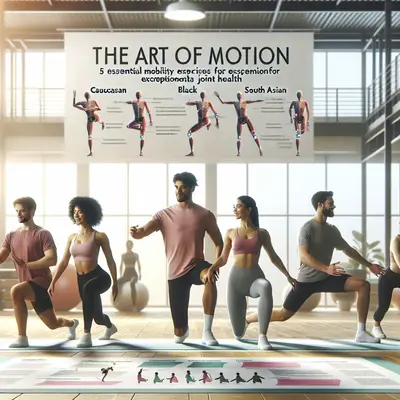
Longevity is no longer measured only in years, but in how gracefully we inhabit our bodies. For those who value joint health as part of a cultivated lifestyle, mobility work is not a trend—it is quiet architecture for the decades ahead. Done well, it feels less like exercise and more like a daily ritual of alignment, control, and respect for your joints’ natural design.
This guide explores mobility exercises through a more elevated lens—precise, intentional, and tailored for lasting joint comfort. Within it are five exclusive insights that discerning readers focused on joint health will recognize as both practical and strategically forward-thinking.
Mobility as Joint Nourishment, Not Just Flexibility
Mobility is often mistaken for simple stretching, but for joint health, it is closer to nourishment than to mere lengthening of muscles. True mobility work focuses on how a joint moves within its socket, not just how far you can reach or bend.
Each joint has an ideal range and quality of motion: smooth, controlled, and evenly supported by both muscles and connective tissue. High-quality mobility training deliberately explores this range under gentle tension, giving cartilage the compression and decompression it needs for nutrient exchange, and encouraging synovial fluid to circulate.
Exclusive insight #1: “Quiet load” is the secret ingredient. Joints respond best not to aggressive pulling, but to controlled, low-intensity movement under light muscular engagement. For example, a slow hip circle while standing and gently bracing your core does more for long-term joint health than forcing a deep static stretch. The goal is to “feed” the joint with motion it can sustain daily, not to chase dramatic ranges that the surrounding tissues cannot support.
Precision Over Performance: The Art of Intentional Repetition
Many mobility routines fail not because of the exercises themselves, but because of how casually they are performed. When it comes to joint longevity, precision is not a luxury—it is the main event.
Slow, deliberate repetitions give your brain time to refine control over each segment of movement. This neuromuscular refinement improves joint stability and reduces the micro-compensations that, over years, contribute to pain and wear. Instead of counting how many repetitions you perform, consider the quality criteria: Is the motion smooth? Does the rest of the body remain quiet? Can you perform the same movement without using momentum?
Exclusive insight #2: Micro-corrections matter more than maximal effort. Ankle circles where you consciously keep the knee still; wrist extensions where each finger remains relaxed; spinal rotations where the pelvis stays grounded—these details teach your joints to move cleanly. Over time, these refined patterns become your default during walking, lifting, and climbing stairs, quietly reducing strain without demanding your constant attention.
Joint-Specific Rituals: Curating a Personal Mobility “Portfolio”
Most people approach mobility with generic full-body routines. For long-term joint health, a more discerning strategy is to curate a personal “portfolio” of joint-specific rituals that reflect your history, lifestyle, and ambitions.
Begin by identifying your “priority joints”—areas with previous injury, family history of arthritis, high daily demand, or early signs of stiffness. For many, this includes hips (sitting), knees (stairs and walking), ankles (balance), and shoulders (desk work). From there, select one or two precise movements for each priority joint, and commit to them as daily non-negotiables rather than occasional extras.
Exclusive insight #3: Consistency with a few movements outperforms variety without intention. You do not need a 40-minute sequence to invest meaningfully in joint health. Five minutes of targeted hip CARs (controlled articular rotations), ankle dorsiflexion work, and gentle thoracic spine rotations performed daily will serve you better than a sporadic, elaborate routine. Think of these as your “core holdings” in a long-term wellness portfolio—quietly compounding benefits over time.
The Underrated Role of Tempo and Breath in Joint Comfort
Tempo—the speed at which you move—has a profound influence on how joints experience load. Fast, jerky movements often bypass the stabilizing musculature and stress passive structures; slow, deliberate tempo invites muscles to participate fully, creating a protective “halo” of support around the joint.
Breath is equally influential. Holding your breath or breathing shallowly during mobility work can increase muscle tension and diminish the elegance of the movement. Smooth, diaphragmatic breathing encourages relaxation where appropriate and firm engagement where needed, particularly around the spine and hips.
Exclusive insight #4: Your breath and tempo are subtle levers for joint ease. Try this refinement: during a controlled knee flexion/extension (for example, a seated leg extension without weight), inhale to prepare, then exhale slowly as you complete the movement, keeping the motion matched to the length of your exhale. This synchrony reduces unnecessary bracing and helps your joints “learn” to move with both strength and softness—an ideal combination for long-term comfort.
Training Joint Resilience for Real Life, Not Just the Mat
The finest mobility work anticipates the realities of daily life: uneven sidewalks, twisting to reach a bag in the back seat, stepping off a curb while distracted. Your mobility practice should subtly rehearse these challenges in a controlled, intelligent way, building resilience rather than fragility.
This means including movements that explore controlled end ranges (the furthest point of safe motion), light rotational forces, and transitions between positions—such as moving from a half-kneeling lunge to standing without using your hands. These patterns teach your joints how to handle shifting forces gracefully, not just in a perfectly aligned exercise setting.
Exclusive insight #5: Train the “edges” of your movement, not just the middle. Joint issues often appear when we ask our bodies to operate suddenly at their limits—quick twists, deep bends, awkward reaches. By occasionally and gently exploring these edges under control—such as slow rotational lunges, gentle spinal rotations with support, or step-downs from a low platform—you inoculate your joints against surprise demands. This is not about courting risk, but about rehearsing resilience in a thoughtful, structured manner.
Conclusion
Joint-preserving mobility is not about athletic bravado or extreme flexibility. It is a refined discipline: intentional movement, curated rituals, elegant control, and respect for the complex engineering of your joints. When practiced with care, mobility work becomes a daily expression of long-term self-respect—quiet, precise, and profoundly effective.
For those who wish to move beautifully not just this year, but decades from now, mobility is less a workout and more a lifestyle signature. Begin with a few joint-specific rituals, elevate your attention to detail, and let quality guide everything else. Over time, your joints will speak in the language of ease, stability, and enduring grace.
Sources
- Harvard Health Publishing – Stretching: Focus on Flexibility – Overview of flexibility and mobility principles and how they support joint health and functional movement.
- Arthritis Foundation – Range-of-Motion Exercises – Practical guidance on joint-friendly motion and why controlled daily movement protects arthritic and at-risk joints.
- Mayo Clinic – Exercise and Arthritis – Evidence-based discussion of how targeted movement improves pain, function, and long-term joint outcomes.
- Hospital for Special Surgery – Joint Mobility and Stability – Insights from a leading orthopedic institution on the relationship between mobility, stability, and injury prevention.
- National Institute on Aging – Exercise and Physical Activity – Research-backed recommendations on movement for healthy aging, including joint-protective strategies.
Key Takeaway
The most important thing to remember from this article is that this information can change how you think about Mobility Exercises.