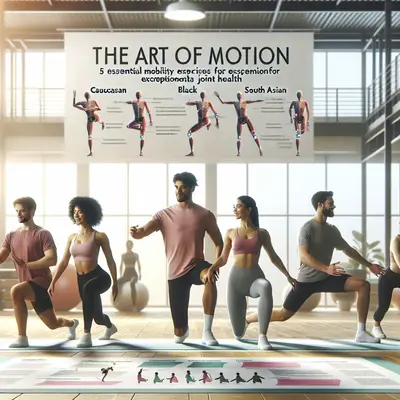
Joint health is rarely lost in a single moment; it erodes in quiet, ordinary ways—through rushed mornings, static workdays, and evenings spent seated. Mobility exercises are the quiet counterargument to that erosion. They are not simply stretches or warm-ups but a refined practice of teaching your joints to move with control, comfort, and confidence. For those who care about aging well—and looking composed while doing it—mobility work becomes less of a fitness trend and more of a daily standard.
Below, we explore a sophisticated approach to mobility training designed for people who expect more from their bodies: more fluidity, more resilience, and more longevity. Woven into this are five exclusive insights that discerning, joint-conscious readers will appreciate.
Mobility, Not Just Flexibility: Training the Space Within the Joint
Flexibility and mobility are often used interchangeably, but they are not the same. Flexibility is passive—the ability of a muscle to lengthen when an external force is applied. Mobility is active—the ability of a joint to move through its range with strength and control. For joint health, mobility is the more protective quality.
When you move actively—lifting your arm overhead with control instead of having it pulled there—you are asking the joint capsule, surrounding muscles, and stabilizing tissues to work together. This creates a kind of “ownership” over your range of motion. Joints that can move, stop, and hold under your own strength are far less vulnerable to awkward twists, sudden slips, or overreaching for something on a high shelf.
Exclusive Insight #1: The “Owned Range” Rule
Instead of chasing extreme range of motion, prioritize the range you can actively control without pain or compensation. For example, if you can pull your knee toward your chest with your hands, but cannot lift it nearly as high under its own power, only the “owned” portion of that range is truly protective. Training that controlled, smaller range—not the passive, photo-worthy one—is where joint resilience is built.
The Morning Scan: Using Mobility as a Daily Status Report
Most people begin their day with coffee; few begin it with a meaningful check-in on how their body feels. For joint-conscious individuals, a short, structured mobility sequence can serve as an early-warning system, catching subtle restrictions before they become lingering issues.
A morning “joint scan” might include gentle neck rotations, shoulder circles, thoracic spine rotations, hip CARs (controlled articular rotations), ankle circles, and a few slow, body-weight squats. Done slowly and with attention, this is less a workout and more a diagnostic ritual. You are asking each major joint: “How are you today?”
Over time, you learn your baseline. A hip that feels slightly “stickier” than usual or a shoulder that catches halfway through its circle is a prompt, not a crisis. It tells you where to dedicate a few extra minutes that day, before the tightness becomes protective guarding, altered movement patterns, or pain.
Exclusive Insight #2: Use Subtle Asymmetries as Your Guide
Instead of ignoring a “slight tightness on one side,” treat those asymmetries as your most intelligent training cues. When one ankle feels less smooth than the other, add two or three extra controlled circles on that side; if one hip is hesitant in rotation, target that direction with careful, repeated reps. Micro-adjustments made early are far more effective than dramatic interventions later.
The Underestimated Luxury of Slow Repetitions
In an age obsessed with intensity and step counts, slow mobility work can feel deceptively simple. It is anything but. Moving a joint deliberately—say, circling your hip while standing, without letting your pelvis tip or your torso lean—requires concentration, neuromuscular coordination, and a refined sense of body position.
Slow mobility repetitions are a kind of moving meditation. They encourage your nervous system to feel safe in new positions, which is crucial for those managing stiffness, past injuries, or arthritis. When your brain does not trust a position, it often responds with tightness or guarding. Gentle, repeated, controlled movements send a calmer, more reassuring message: “This is okay. We can be here.”
Exclusive Insight #3: Time Under Tension for Joints, Not Just Muscles
We often associate “time under tension” with muscle building, but the same principle applies elegantly to joints. Performing a shoulder circle that takes 15–20 seconds instead of five forces the smaller stabilizing muscles to participate, and it teaches your body to stay organized throughout the entire motion. This extended, low-intensity tension nourishes cartilage through improved synovial fluid movement and builds quiet endurance in the tissues that protect your joints.
Mobility as an Anti-Friction Strategy for Modern Living
Modern life is full of invisible “friction” against joint health: long commutes, static screens, one-sided habits (like always crossing the same leg or carrying the same bag). Mobility exercises are not just about making joints looser; they are about restoring balance in a life that constantly pushes us into repetitive positions.
Think of your joints as precision-engineered hinges. When they sit in one position for hours, the tissues stiffen and lose their readiness to move in other directions. A carefully chosen mobility practice counters this by deliberately exploring the directions your day neglects: external rotation for internally rotated shoulders, hip extension and rotation for hours of sitting, ankle dorsiflexion for feet that rarely bend beyond office shoes.
Exclusive Insight #4: “Opposition Practice” for Everyday Postures
For every dominant position in your day, design a complementary mobility move:
- Sit often? Favor hip extension and rotation drills, and gentle spinal extension.
- Type for hours? Add wrist circles, finger mobility, and forearm stretches.
- Stand frequently? Use ankle dorsiflexion and calf-focused mobility plus gentle knee bending drills.
By thinking in terms of opposites, your mobility routine becomes an elegant counterbalance to your lifestyle, not just a generic collection of stretches.
When Strength and Mobility Become the Same Conversation
A sophisticated mobility approach does not separate strength and motion; it integrates them. Joints do not simply need to move; they need to move under light load, at different speeds, and with quiet confidence. This is particularly important for people concerned about arthritis, joint replacements, or maintaining independence as they age.
Consider exercises like deep, supported split squats where you gently explore knee and hip range, or a controlled chair sit-to-stand where you focus on smoothness, alignment, and joint comfort instead of speed. These are mobility drills disguised as strength work—or strength drills disguised as mobility work. The distinction becomes less important than the quality of how you move.
Exclusive Insight #5: Load as a “Conversation Starter,” Not an Attack
Light external load—a resistance band, a small weight, or even just your body weight in a new angle—can be a powerful tool for joint health when introduced thoughtfully. The key is to treat load as a way to ask your joints how they are doing, not to force adaptation. If a movement feels better, smoother, and more stable with a modest amount of resistance, that is often a sign that your nervous system feels more organized under gentle challenge. This can be especially helpful for knees, hips, and shoulders that feel unstable or “noisy” when moved passively.
Conclusion
Mobility work, at its most refined, is not about chasing extreme flexibility or joining the latest fitness trend. It is about cultivating joints that feel trustworthy—capable of supporting a long, active, and elegant life. When you prioritize “owned” ranges of motion, use daily mobility as a diagnostic ritual, slow down your repetitions, counterbalance your lifestyle with opposition practice, and blend strength into your mobility, you create a practice that is both protective and deeply rewarding.
The result is subtle yet unmistakable: a body that moves quietly well. Joints that glide instead of grind. And a sense that, while age is inevitable, the way you inhabit your body is very much a choice—one that can feel luxurious, deliberate, and deeply intelligent.
Sources
- [Harvard Health Publishing – Stretching and flexibility: How to stretch properly](https://www.health.harvard.edu/staying-healthy/stretching-and-flexibility-how-to-stretch-properly) – Discusses the difference between flexibility and mobility and safe approaches to movement
- [Arthritis Foundation – The importance of movement for arthritis](https://www.arthritis.org/health-wellness/healthy-living/physical-activity/getting-started/the-importance-of-movement) – Explains how gentle, regular movement supports joint health, especially for arthritis
- [Mayo Clinic – Exercise: 7 benefits of regular physical activity](https://www.mayoclinic.org/healthy-lifestyle/fitness/in-depth/exercise/art-20048389) – Outlines broad health benefits of movement, including joint and functional health
- [Cleveland Clinic – Range of Motion Exercises](https://my.clevelandclinic.org/health/treatments/16841-range-of-motion-exercises) – Provides clinical context for active versus passive range of motion and why it matters for joints
- [Johns Hopkins Medicine – Arthritis and Exercise](https://www.hopkinsarthritis.org/patient-corner/disease-management/arthritis-and-exercise/) – Reviews how appropriately dosed exercise and mobility support joint comfort and longevity
Key Takeaway
The most important thing to remember from this article is that this information can change how you think about Mobility Exercises.