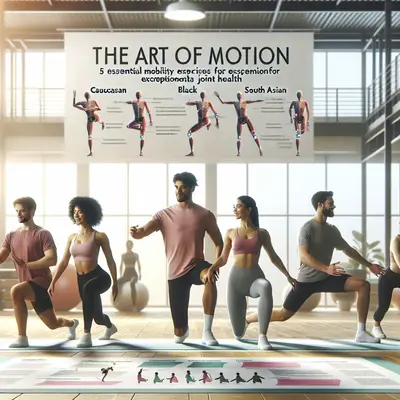
Joint‑healthy mobility is not about dramatic workouts or flashy routines; it is about cultivating a poised, responsive body that moves with ease in real life. For the discerning individual, mobility work becomes less of a chore and more of a daily refinement ritual—subtle, precise, and deeply protective of long‑term joint health. When mobility is approached with intention, the result is not only less pain and stiffness, but also a more elegant, confident way of inhabiting your own body.
Below, we explore a curated perspective on mobility exercises, anchored in five exclusive insights that those serious about joint longevity quietly prioritize.
Mobility as “Joint Hygiene,” Not Occasional Rehab
Most people reach for mobility drills only when something hurts. By then, they are already negotiating with inflammation, compensation patterns, and reduced range of motion. A more refined approach is to treat mobility as “joint hygiene”—quiet, daily upkeep that preserves the integrity of cartilage, ligaments, and connective tissue long before symptoms appear.
When you integrate 5–15 minutes of mobility work into your morning or evening routine, you are effectively rinsing the joints with fresh synovial fluid, guiding them gently through their full, available range. Gentle controlled circles for the neck, shoulders, wrists, hips, knees, and ankles can be performed standing or seated, with deliberate, unhurried attention. This repetition teaches your nervous system that these ranges are safe, which in turn allows muscles to relax protective tightness. Over weeks and months, the joints “remember” these rehearsed positions, making them more resilient to the unexpected demands of modern living—long flights, low sofas, steep stairs, or a sudden sprint in the rain.
Those focused on joint health do not wait for crisis; they treat mobility like brushing their teeth—a non‑negotiable ritual that quietly prevents far larger problems.
Luxurious Precision: Slow, Single‑Joint Control Over Big Movements
Intelligent mobility training does not begin with grand, sweeping motions; it begins with exquisite control of a single joint at a time. Instead of chasing maximal stretching, the emphasis turns toward precision—how cleanly can your hip rotate, how smoothly can your shoulder glide, how elegantly can your spine segment?
One refined practice is to choose a single region—say, the hip—and explore it with slow, controlled articular rotations. Standing with one hand on a stable surface, lift the knee just slightly, then draw a small, deliberate circle with strict attention to what moves and what stays quiet. The pelvis remains composed, the spine long, the core lightly engaged, while the hip joint performs the artwork. The goal is not to move far; it is to move purely.
This kind of single‑joint training nourishes cartilage by moving it through diverse angles, supporting diffusion of nutrients in areas with limited direct blood supply. It also trains the brain to differentiate between joints (a concept called “joint independence”), preventing the kind of sloppy, compensatory movement that can overload the knees when the hips are stiff, or strain the lower back when the thoracic spine is rigid. Precision becomes a luxury that your joints learn to rely on every time you walk, climb, or bend.
The Quiet Power of End‑Range Strength
Classic stretching tends to stop at a feeling of “pull” and passively hold the position. A more advanced joint‑centric strategy goes one step further: gently strengthening the muscles at the very edges of your comfortable range of motion. This is called end‑range strength, and it is one of the most underappreciated secrets of long‑term mobility.
When you support a new range with strength, your nervous system perceives it as safe. For example, in a gentle lunge stretch for the hip flexors, instead of simply resting into the stretch, you might spend the last 10–15 seconds lightly engaging the muscles around the front of the hip, as though you were trying to pull the leg back under you without actually moving. The contraction is small but precise, creating an elegant balance: the joint is both open and supported.
End‑range work is especially valuable around the ankles, hips, and shoulders—joints that orchestrate most of our daily movement and tend to be vulnerable to stiffness and instability. Whether you are descending stairs, pivoting on a tennis court, or simply stepping off a curb in the dark, it is not just flexibility that protects you; it is strength in those “edge” positions. Cultivating this capacity is a quiet form of insurance: less drama during life’s unscripted motions, and far fewer surprises for your joints.
Micro‑Mobility: Weaving Joint Care into a High‑Demand Day
Those with busy, demanding lives rarely have the luxury of long gym sessions. What they do have is a series of micro‑moments—between calls, in the kitchen, at the airport gate—that can be transformed into sophisticated mobility opportunities. This is where micro‑mobility comes in: elegant, nearly invisible drills that seamlessly integrate into the day.
Consider a standing call as a chance to perform subtle ankle and knee articulation: small heel raises, slow bending and straightening of the knees, or gentle shifting of weight from side to side to awaken the hips. At your desk, you might sit tall and explore controlled pelvic tilts, tiny thoracic rotations, or neck glides—chin slightly forward and back—keeping the movements small but intentional. In a lift or queue, you can practice delicate shoulder blade circles beneath your jacket, reminding the upper back not to freeze.
These micro‑sessions, even 60–90 seconds at a time, help interrupt the stagnation of prolonged sitting and standing. Over a week, they can accumulate into more joint nourishment than a single, heroic weekend workout. The refined insight here is simple: joint health is not merely built in the gym; it is curated in the in‑between spaces of your day.
Rhythmic Mobility: Marrying Breath, Tempo, and Joint Ease
The most discerning approach to mobility treats each session less like a checklist and more like a moving meditation—uniting breath, tempo, and alignment into a coherent whole. When the breath is shallow and rushed, the nervous system interprets movement as stressful, often responding with muscle guarding and increased tension around the joints. When breath and tempo are deliberate, the body receives a different message: safety, permission, release.
Begin by assigning a rhythm to your mobility drills. For example, in a seated spinal rotation, inhale as you gently lengthen the spine, exhale as you rotate a few degrees, pause briefly, then inhale back to center. Move slowly enough that you could, in theory, stop at any point without losing control. This unhurried cadence invites deeper sensory awareness—what does the joint feel like at the start of the move, in the middle, at the end? Are both sides symmetrical, or does one feel “gravelly” or reluctant?
Over time, this rhythmic, breath‑anchored approach becomes a refined feedback loop. You start to notice early hints of joint irritation—mild stiffness in one hip, a slightly sticky shoulder on one side—and you respond with tailored mobility instead of waiting for pain to escalate. Breath and tempo transform mobility from something you “do” to something you inhabit: a poised, continuous dialogue with your joints.
Conclusion
Sophisticated mobility work is not loud, complicated, or performative. It is quiet, attentive, and exquisitely consistent—joint hygiene as daily ritual, precision over spectacle, stability at the end ranges, micro‑sessions woven into real life, and breath‑linked rhythm as the backdrop. When you treat mobility as an elevated practice rather than a last‑minute fix, your joints respond with a kind of understated luxury: less stiffness, fewer surprises, and a calm confidence in the way you move through the world.
For those invested in long‑term joint health, this is the real mark of refinement—not just how far you can move today, but how gracefully you will still be moving decades from now.
Sources
- [Harvard Health Publishing – Stretching: Focus on Flexibility](https://www.health.harvard.edu/staying-healthy/stretching-focus-on-flexibility) – Overview of flexibility and mobility principles, including safe stretching and joint range of motion
- [Arthritis Foundation – Range-of-Motion Exercises](https://www.arthritis.org/health-wellness/healthy-living/physical-activity/stretching/range-of-motion-exercises) – Practical guidance on gentle joint mobility routines for arthritis and stiffness
- [American Academy of Orthopaedic Surgeons – Joint Health](https://orthoinfo.aaos.org/en/staying-healthy/exercise-and-bone-health/) – Evidence‑based recommendations on exercise, joint function, and long‑term musculoskeletal health
- [Mayo Clinic – Exercise: 7 Benefits of Regular Physical Activity](https://www.mayoclinic.org/healthy-lifestyle/fitness/in-depth/exercise/art-20048389) – Explains systemic health benefits of consistent movement, including joint protection and function
- [Cleveland Clinic – Synovial Joints: Function, Types & Conditions](https://my.clevelandclinic.org/health/body/23653-synovial-joints) – Detailed explanation of how synovial joints work and why controlled movement supports joint health
Key Takeaway
The most important thing to remember from this article is that this information can change how you think about Mobility Exercises.