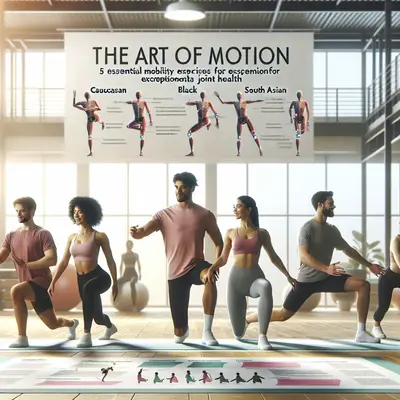
Mobility is not simply about “stretching more.” It is the quiet refinement of how your body moves through space, how your joints share load, and how gracefully you transition from one position to the next. For those who care deeply about preserving joint health, mobility work becomes less of a workout add-on and more of a daily standard—an investment in elegance, longevity, and physical confidence.
Below, we explore mobility exercises through a more discerning lens, with five exclusive insights that go beyond generic advice and speak directly to those curating a higher standard of joint care.
Mobility as Joint “Currency”: Where You Spend It Matters
Mobility can be thought of as a form of currency: you have a finite range of motion at each joint, and how you habitually move determines where you “spend” that range over time. Many people repeatedly load the same small portion of a joint’s range—like always squatting to the same shallow depth or only reaching overhead halfway—leaving other angles underused and vulnerable.
This uneven usage is one reason why pain often appears not in dramatic moments, but in quiet, ordinary ones: lifting luggage into an overhead bin, stepping off a curb, or pivoting on a wet floor. A refined mobility practice deliberately explores the full, comfortable arc of motion at each joint—hips, ankles, shoulders, and thoracic spine—under light control. Think of slow, deep hip circles, controlled arm arcs against a wall, or ankle rolls performed with focus and even pressure. The goal is not maximal flexibility, but even distribution: you are training every degree of your available range to be usable, strong, and trustworthy.
When you treat mobility like currency, you begin to notice your “spending habits”: are you always moving through the same patterns, in the same shoes, on the same surfaces, at the same speeds? Introducing controlled variety—different step lengths, gentle lateral reaches, diagonal lunges within your comfort—ensures your joints are not overtaxed in a narrow slice of their capacity.
The Art of Slow Tension: Why Tempo Matters More Than Intensity
For joint health, the speed of your mobility work often matters more than how far you move. Rapid, ballistic movements can outpace your neuromuscular control, especially when joints are irritated or arthritic. In contrast, slow, deliberate mobility creates time for your brain to sense joint position, adjust muscle tension, and refine alignment in real time.
Consider transforming a simple hip hinge into a “luxury tempo” exercise: stand tall, soften your knees, then slowly fold at the hips over 5–7 seconds, pausing at the first point of mild stiffness, not pain. Linger there, breathing calmly, then return to standing just as slowly. This controlled tempo turns a basic pattern into joint-focused training: your hamstrings lengthen in a measured way, your hips learn to hinge without excessive strain on the low back, and your nervous system files this as a “safe” position.
This principle applies equally to shoulder, ankle, and spine mobility. Slow shoulder circles, for example, reveal subtle “catches” or compensations you might rush past at normal speed. By deliberately moving just beneath your threshold of discomfort, you train your joints to tolerate slightly more motion while reinforcing stability. Over time, this combination of patience and precision can be more protective than aggressively chasing range.
Micro-Mobility: Elegant Adjustments Hidden in Daily Life
Highly effective mobility work doesn’t need to announce itself as a “session.” Some of the most joint-protective habits are embedded as quiet upgrades in the way you already move. Think of these as micro-mobility moments—small, intentional adjustments layered onto routine activities.
When you rise from a chair, for example, deliberately place your feet hip-width apart, hinge slightly at the hips, and drive evenly through both feet instead of pushing off a single side or using your hands for momentum. That single repetition becomes a loaded mobility drill for hips, knees, and ankles.
Similarly, while brushing your teeth, you might gently shift your weight from one leg to the other, exploring small ankle, knee, and hip bends without locking any joint. When reaching for high shelves, use a full, controlled overhead reach with a long spine, not a quick shrug and twist. Waiting at a counter or standing in line is an opportunity for subtle calf raises, ankle circles inside your shoes, or gentle pelvic tilts that mobilize the lower back and hips.
These strategies are small, but their cumulative impact is substantial. They convert your day into a low-intensity, continuous mobility practice that keeps joints warm, nourished, and responsive—without needing an extra hour carved out of your schedule.
Precision Over Depth: How Joint Alignment Outperforms “Going Further”
In joint-focused mobility, more range is not automatically better; better quality is better. Many people unconsciously “borrow” motion from one joint when another is stiff—for instance, rounding the lower back to compensate for tight hips, or jamming the neck forward when shoulder range is limited. These compensations may look like improved flexibility but often shift stress onto more vulnerable structures.
Prioritizing alignment means deliberately moving to the edge of your range while keeping surrounding segments organized. During a lunge-based mobility drill, for example, you might keep the front knee tracking gently over the middle toes, the pelvis level, and the torso tall rather than collapsing forward. You stop at the first meaningful stretch where you can maintain clean lines—not at the deepest possible position.
For the spine, precision might mean exploring gentle thoracic rotation (upper back twisting) while keeping the pelvis quiet, rather than twisting your hips and calling it “spinal mobility.” Shoulder work may involve sliding your arm up a wall while keeping the ribs from flaring forward. These details are not cosmetic; they determine whether load is distributed across the joint surfaces as nature intended or concentrated in a stressed region.
Over time, precision-focused mobility enhances joint congruency (how well joint surfaces meet), supports cartilage health via evenly distributed pressure, and teaches your body to move gracefully under real-world demands. The refined goal: joints that feel “centered” and predictable, not simply loose or overstretched.
Mobility as an Anti-Inflammatory Ritual, Not Just a Mechanical Fix
Mobility exercises are often discussed purely in mechanical terms—improving range, lubricating joints, strengthening end ranges. Yet for those living with arthritis or chronic joint sensitivity, mobility can also function as a subtle, daily anti-inflammatory ritual.
Gentle, rhythmic movement encourages synovial fluid circulation within joints, which helps nourish cartilage and may support smoother motion. Beyond the joint itself, controlled mobility lowers overall muscular tension, which can reduce the “background noise” of pain signals. Paired with slow, measured breathing, it can also dial down the sympathetic (“fight or flight”) nervous system, which plays a role in pain perception and inflammatory responses.
Imagine a brief evening sequence—5–10 minutes—of smooth ankle circles, gentle cat-cow movements for the spine, slow shoulder arcs, and light hip openers, all performed with calm nasal breathing and no rush. This is not a workout; it is a reset. As a daily ritual, it signals to your body that motion is safe, joints are being cared for, and tension can soften. Over time, this can complement medical treatments, good sleep, and nutrition in a holistic approach to joint-friendly living.
The refined perspective is to view mobility as hygiene rather than repair: much like you would not skip brushing your teeth and expect lasting dental health, you do not neglect joint motion and expect them to remain comfortable and resilient. Regular, low-intensity mobility becomes part of a personal standard of care—quiet, consistent, and profoundly protective.
Conclusion
A sophisticated approach to mobility moves beyond generic stretching routines and into a more curated practice: one that respects tempo, alignment, and daily context. By treating mobility as a form of joint currency, emphasizing slow tension over intensity, embedding micro-mobility into your day, prioritizing precision over depth, and embracing mobility as an anti-inflammatory ritual, you cultivate joints that move with confidence and ease.
For those who view their health as something to be intentionally designed rather than simply maintained, mobility exercises are not optional extras. They are the daily craftsmanship behind enduring, elegant movement.
Sources
- Harvard Health Publishing – Stretching: Focus on Flexibility – Overview of safe flexibility practices and how they support joint function
- Johns Hopkins Medicine – Arthritis and Exercise – Explains why controlled movement and exercise are essential in managing arthritis and protecting joints
- Mayo Clinic – Arthritis: Movement and Exercise – Discusses the benefits of gentle, regular activity for joint health and pain reduction
- Cleveland Clinic – Joint Health and Physical Activity – Details how carefully chosen movement patterns can support long-term joint integrity
- NIH – Physical Activity and Your Health – Government-backed guidance on safe, regular physical activity, including mobility, as a cornerstone of healthy aging
Key Takeaway
The most important thing to remember from this article is that this information can change how you think about Mobility Exercises.