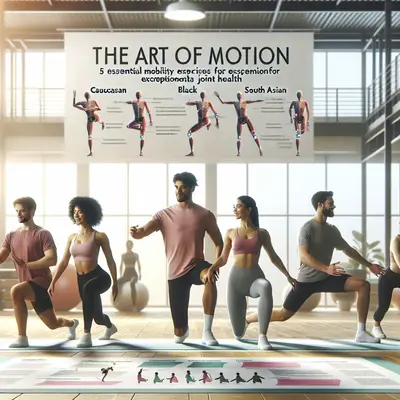
Mobility work, when done well, feels less like a workout and more like a quiet upgrade to the way you move through the world. It’s the difference between bracing yourself for stairs and taking them as an afterthought, between feeling “stuck” in your body and inhabiting it with composure. For those who care deeply about joint health, mobility is not a trend; it is a daily act of preservation—a way to ensure that strength, elegance, and comfort can coexist in every decade of life.
This is mobility training viewed through a more refined lens: not simply stretching, not merely exercise, but a curated practice of joint nourishment. Below are five elevated, often overlooked insights that transform mobility work from a checklist into a truly luxurious expression of self-care for your joints.
Mobility as “Joint Hygiene,” Not Just Flexibility
Most people treat mobility as an optional add-on, something to be done if time allows. A joint-focused perspective reframes it as “joint hygiene”—the movement equivalent of brushing your teeth.
Just as plaque accumulates when oral care is neglected, stiffness and subtle restrictions accumulate in joints that are never moved through their full, comfortable range. Cartilage relies on movement to receive nutrients via synovial fluid, and immobility starves this process. Structured mobility work—ankle circles, controlled hip rotations, gentle spinal waves—acts like a daily rinse for your joints, clearing mechanical “debris” and refreshing lubrication.
This isn’t about contortion-level flexibility. It’s about deliberately exploring the range your joints were designed for: ankles that can glide forward over the toes without strain, hips that rotate freely, shoulders that can reach overhead without compensatory arching of the low back. When mobility is practiced as hygiene, it becomes brief, frequent, and non-negotiable—woven seamlessly into transitions like waking, pre-work, or winding down at night.
The Art of Tempo: Slower Reps, Smarter Joints
For joint health, how you move is often more important than how much you move. Tempo—the speed of each repetition—functions like an internal magnifying glass, revealing how your joints and tissues truly behave.
Fast, careless repetitions allow momentum to hide weaknesses. Slow, deliberate motion exposes them. When you move an ankle, hip, or shoulder slowly enough that you can notice exactly where the sensation shifts, where control falters, or where you instinctively hold your breath, you gain data that is clinically useful, not just “interesting.”
Try this refinement: take a movement you already perform (such as a lunge or bodyweight squat) and slow each repetition to a five-count down and a three-count up. Focus on tracking where your knees, hips, and ankles travel. Do they stay aligned, or drift? Does one side feel subtly less secure? This tempo-based awareness does three powerful things for joint health:
- It reduces shear and abrupt loading on cartilage and ligaments.
- It trains smaller stabilizing muscles that safeguard each joint.
- It teaches your nervous system to trust positions that previously felt vulnerable.
Slow is sophisticated when it comes to joint care. You gain not only strength and mobility, but also composure in motion.
Micro-Mobility: The Luxurious Power of One-Minute Interludes
Elite joint care doesn’t rely solely on long workouts; it thrives on exquisite micro-moments scattered throughout the day. This is micro-mobility: intentional, one- to three-minute intervals of movement that prevent stiffness from ever accumulating to problematic levels.
Consider these micro-mobility “interludes”:
- At your desk: every 45–60 minutes, stand and perform 10 slow calf raises while gently circling the ankles in between.
- In the kitchen: while waiting for water to boil, practice gentle hip hinges, feeling the hamstrings lengthen while keeping the spine neutral.
- Before sleep: a 90-second routine of cat-cow spinal waves, then side-lying open-book rotations to nourish the thoracic spine and rib cage.
This approach acknowledges a crucial insight: joints adapt more beautifully to frequent small doses of movement than to occasional heroic efforts. Micro-mobility keeps tissue viscosity, blood flow, and joint lubrication in a quietly optimal state. Over months and years, these seemingly minor interludes compound into significantly better range of motion, less discomfort, and more confident movement.
Aligning Strength With Mobility: A Joint-Centric Synergy
Mobility without strength can feel unstable; strength without mobility can feel compressed and restricted. Joints function best when those two qualities are trained together, not in isolation.
A joint-focused approach looks for ways to “load the range” safely. Instead of only stretching the hips and then separately lifting weights for the legs, you might practice:
- Split squats that gently approach a deeper hip and knee bend over time, with controlled descent and ascent
- Romanian deadlifts using a light-to-moderate load, emphasizing length through the posterior chain while maintaining spinal integrity
- Overhead presses with light weights and scrupulous shoulder positioning, building strength in the very range you wish to preserve
This integrated strategy makes mobility more durable. Strong tissues reinforce joints at end ranges, giving your nervous system the reassurance it needs to “permit” greater motion without pain or excessive guarding. Over time, range of motion gained through mobility work becomes range of motion you can use—walking, climbing, lifting, and reaching with ease, not hesitation.
For those deeply invested in joint longevity, this is the refinement: don’t simply move further; move further under gentle, intelligent load.
Sensation as Data: Reading Your Joints With Precision
The most sophisticated mobility practitioners are exquisitely attuned to nuance. They don’t sort sensations into just “good” or “bad”; they distinguish between stretch, pressure, tension, and actual pain. This sensory literacy is one of the most underrated skills in joint preservation.
A few guiding distinctions:
- Productive sensation often feels like mild to moderate tension, warmth, or a feeling of “lengthening” that eases shortly after you exit the position.
- Joint irritation may feel sharp, catching, pinching, or deep inside the joint, especially if it lingers or worsens the next day.
- Nervous system sensitivity can feel like widespread tightness, guarding, or a disproportionate reaction to light movement.
Instead of forcing rigid routines, a refined approach adapts daily mobility to what your joints “report” back. On a day when your knees feel irritable, you might prioritize gentle cycling, aquatic movement, or non-weightbearing mobility drills rather than deep squats. When your spine feels fresh, you might explore a more generous range of rotation and extension.
This responsiveness is not indulgence—it is strategy. Research increasingly supports the value of graded, tolerable movement for arthritis and joint pain, rather than immobilization or purely passive rest. When you treat sensations as information, not inconvenience, your mobility practice becomes a dialogue with your joints, not a monologue imposed upon them.
Conclusion
Mobility work for joint health does not need to be theatrical to be profoundly effective. In many ways, the most luxurious approach is the quietest: daily “joint hygiene,” sophisticated tempo, elegantly brief micro-mobility breaks, intelligent pairing of strength and range, and a high level of sensory awareness.
These practices don’t just keep you moving; they refine how you move—more fluidly, more confidently, and with a sense of ease that feels increasingly rare in a rushed, screen-bound world. When you invest in your joints with this level of attention and subtlety, you’re not simply preventing problems; you’re curating a physical life that feels both capable and composed, year after year.
Sources
- Arthritis Foundation – Flexibility Exercises – Practical guidance on safe flexibility and mobility work for people with joint concerns
- Harvard Health Publishing – The Importance of Stretching – Overview of how regular mobility and stretching support joint function and overall movement
- Mayo Clinic – Exercise and Arthritis – Evidence-backed explanation of why appropriately dosed movement benefits arthritic joints
- NIH MedlinePlus – Joint Health and Aging – Educational resource on joint disorders and the role of movement in management and prevention
- American College of Sports Medicine – ACSM’s Guidelines for Exercise Testing and Prescription (Overview) – Professional framework for prescribing safe, effective exercise, including mobility and strength for different populations
Key Takeaway
The most important thing to remember from this article is that this information can change how you think about Mobility Exercises.