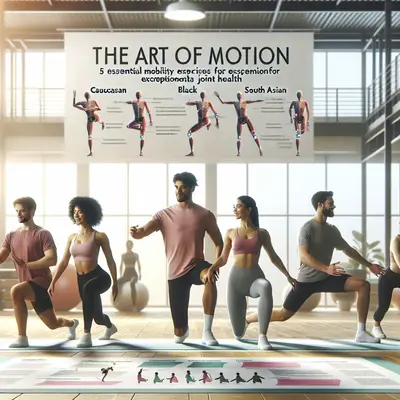
Mobility is not simply the absence of stiffness; it is the quiet refinement of how your body occupies space. For those who prize longevity, clarity of movement, and a sense of physical composure, mobility work becomes less of a workout and more of a daily ritual. This is where joint health moves beyond “stretching” and enters the realm of deliberate, intelligent refinement—where each movement protects cartilage, preserves fluid glide, and sustains your ability to move with ease and authority, year after year.
Redefining Mobility: Beyond Flexibility and Strength
Mobility is often mistaken for flexibility or strength, yet it is neither in isolation. True joint mobility is your ability to control a joint through its available range with precision, stability, and minimal discomfort. Where flexibility speaks to how far tissues can lengthen, mobility speaks to how well you can use that range under your own control.
For joint-conscious individuals, this distinction matters. A hamstring that can stretch to the floor is of limited value if your hip cannot rotate smoothly or your knee cannot track confidently under load. Mobility training targets the joint capsule, the surrounding musculature, and the neuromuscular connection that orchestrates controlled movement. It improves how synovial fluid circulates, how cartilage is nourished, and how ligaments are protected during everyday tasks and high-demand activities.
By reframing mobility as a disciplined practice—rather than a warm-up afterthought—you elevate it to its rightful place: the foundation of joint longevity and refined movement.
Insight 1: The “Joint Inventory” – A Daily Audit of Your Range
Those serious about joint health don’t wait for pain to signal a problem. They perform a daily “joint inventory”: a brief, methodical check-in with key joints to notice subtle changes in motion, texture, and comfort.
Begin with the neck, shoulders, elbows, wrists, spine, hips, knees, and ankles. Gently explore each joint through slow circles, controlled arcs, and light rotations. The objective is not to “stretch hard” but to observe: Is one side tighter? Does a certain angle feel grainy, sticky, or unstable? Does yesterday’s easy range now feel guarded?
This refined awareness does two things. First, it gives you an early warning system—small restrictions can be addressed before they evolve into pain or injury. Second, it guides your daily mobility ritual: you target what needs attention today, rather than following a generic routine. Over time, this inventory becomes as automatic as checking your calendar, and just as critical to how your day unfolds.
Insight 2: Capsule-First Thinking – Training the Architecture of the Joint
Most mobility programs fixate on muscles, but the “architecture” of the joint—the capsule and surrounding connective tissues—quietly dictates how well you move. For discerning joint care, this is where your focus becomes more sophisticated.
Joint capsules are dense, fibrous structures that envelop the joint. When they become restricted from inactivity, past injuries, or prolonged postures, they limit movement quality even if muscles are strong and flexible. Capsule-focused mobility emphasizes slow, end-range loading where the joint approaches—not surpasses—its available limits under full control.
Examples include:
- Deep, controlled hip rotations (internal and external) while seated or lying down
- Shoulder circles performed slowly at the very edge of your range, with strict stability of the torso
- Gentle end-range ankle dorsiflexion (knee over toes) with calm, sustained breathing
This approach sends a clear signal to the brain and connective tissues: “This range is safe, supported, and controlled.” With consistency, the capsule gradually remodels, granting you a cleaner, more luxurious range of motion. For joint health aficionados, capsule-first thinking transforms mobility work from generic stretching into precision engineering.
Insight 3: Time Under Tension – The Luxury of Slowness
In an era obsessed with efficiency, slowness has become a luxury—and in mobility training, it is a powerful one. Time under tension is the principle of spending enough time at challenging ranges for tissues and the nervous system to adapt. Rather than bouncing, rushing, or “checking the box,” you deliberately dwell in the range you’re trying to cultivate.
For joint health, this means:
- Holding controlled end-range positions for 20–60 seconds while maintaining smooth breathing
- Moving through arcs of motion at a tempo that feels almost uncomfortably slow
- Resisting the urge to “escape” as soon as you feel mild discomfort (while always avoiding sharp pain)
This slowness allows your brain to recalibrate its perception of threat, letting muscles gradually release and joint structures adapt. It also trains fine motor control—microscopic adjustments in how you stabilize and guide movement. The result is not just increased range but usable, resilient range: joints that feel composed rather than precarious at their limits.
For individuals who value both performance and longevity, time under tension is the difference between fleeting looseness and enduring, confident motion.
Insight 4: Rotational Control – The Overlooked Dimension of Joint Health
Most people move primarily forward and backward—walking, sitting, climbing stairs. Yet healthy joints thrive on rotation: the subtle twisting and spiraling motions that keep cartilage nourished and ligaments capable.
Rotational mobility is particularly crucial at the hips, shoulders, and spine. Consider:
- Hip rotation: Essential for walking, getting in and out of cars, and preventing compensatory strain on the knees or lower back.
- Shoulder rotation: Protects the rotator cuff and supports overhead activities, from lifting luggage to refined athletic movements.
- Spinal rotation: Maintains disc health and allows you to turn, reach, and rotate without stress migrating to a single segment.
Refined joint care allocates deliberate time to rotation. Seated hip internal and external rotations, controlled “windshield-wiper” movements, standing thoracic spine rotations, and slow shoulder internal/external rotations with a light band all cultivate this neglected dimension.
Those who prioritize rotational control often notice an elegant side effect: movements like walking, turning, or reaching feel more fluid, almost “spiral-like,” with tension distributed intelligently rather than concentrated in a single vulnerable point.
Insight 5: Micro-Sessions – Integrating Mobility into a Cultivated Day
A sophisticated approach to mobility respects your time and your lifestyle. Instead of a single, heroic weekly stretching session, you create brief, intentional “micro-sessions” that fit seamlessly into your day and nourish your joints repeatedly.
Examples of micro-sessions include:
- Two minutes of ankle and hip circles while your coffee brews
- Gentle thoracic spine rotations during a mid-morning screen break
- Controlled wrist and finger mobility while a file downloads or a video buffers
- A short hip and knee inventory before stepping into a demanding meeting or workout
These micro-sessions acknowledge a critical truth: joints respond best to frequent, low-intensity exposure rather than sporadic extremes. They keep synovial fluid moving, tissue temperature slightly elevated, and the nervous system accustomed to a wide, safe range of motion.
For someone invested in joint longevity, this approach feels less like “exercise homework” and more like a curated rhythm of the day—short, precise, and quietly powerful.
An Elegant Mobility Ritual: Putting It All Together
To translate these insights into practice, consider a concise, daily ritual that honors both efficiency and depth:
Joint Inventory (3–5 minutes)
Scan neck, shoulders, spine, hips, knees, and ankles with slow circles and bends. Note any asymmetries or subtle restrictions.
Capsule-Focused Work (5–10 minutes)
Choose one key area (e.g., hips or shoulders). Spend focused time at end range with slow, controlled rotations and holds. Maintain unhurried breathing.
Rotational Emphasis (3–5 minutes)
Integrate rotational work: hip rotations, thoracic twists, or shoulder internal/external rotation. Keep the movement smooth, never forced.
Micro-Sessions Throughout the Day
Add two or three 2-minute sessions: ankles at your desk, wrists between tasks, or gentle spinal rotations after prolonged sitting.
This structure respects your schedule while delivering the nuanced inputs joints require: attention, precision, and consistent, intelligent loading.
Conclusion
Mobility, at its highest expression, is not a spectacle of extreme flexibility but a quiet confidence in how your body moves through the world. For those who value joint health as a lifelong asset, mobility training becomes an elegant practice of stewardship—preserving glide, stability, and strength in equal measure.
By approaching mobility with a joint inventory mindset, focusing on the capsule, embracing deliberate slowness, cultivating rotation, and weaving micro-sessions into your day, you transform simple movements into a powerful form of preventative care. The reward is not merely the absence of pain, but the presence of something far more compelling: a sense of unhurried, composed movement that feels as refined as the rest of your life.
Sources
- Arthritis Foundation – Range-of-Motion and Flexibility Exercises – Overview of how joint range-of-motion work supports arthritis management and joint comfort
- Harvard Health Publishing – Exercising with Osteoarthritis – Explains why controlled, regular movement is critical for joint health and cartilage nutrition
- Mayo Clinic – Stretching: Focus on Flexibility – Discusses benefits of flexibility and mobility work, with guidance on technique and safety
- NIH – Osteoarthritis: In Depth – Comprehensive evidence-based review of osteoarthritis, including the role of movement and exercise
- Cleveland Clinic – Joint Health: Keeping Your Joints Healthy – Practical recommendations on daily habits, movement, and lifestyle factors that protect joints over time
Key Takeaway
The most important thing to remember from this article is that this information can change how you think about Mobility Exercises.