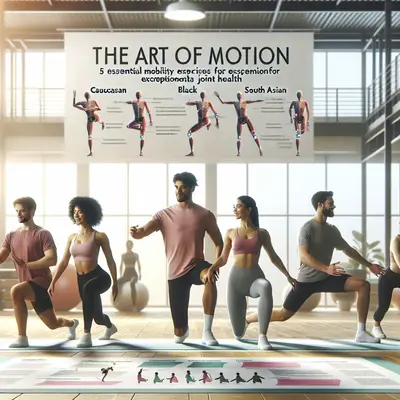
Mobility work is often treated as a warm-up or a chore—something squeezed in after “real” exercise. For joints that you expect to serve you elegantly for decades, that mindset is far too casual. When approached as a daily ritual rather than a quick fix, mobility becomes a quiet but powerful investment: poised movement, less friction, and a body that feels composed instead of compromised. This is mobility for people who expect a high standard from their health—not just “no pain,” but fluid, confident motion in every setting, from the gym to the boardroom.
Below are five exclusive, high-level insights into mobility training that discerning joint‑focused readers will appreciate—each one a refinement beyond the usual “just stretch more” advice.
Insight 1: Train Joint Glide, Not Just Muscle Stretch
Most mobility routines obsess over muscles, yet joints experience movement as “glide”: the subtle, controlled slide and roll between bones, cartilage, and connective tissues. When this glide is smooth and well-trained, even simple movements feel more refined—less strain, more control, and fewer abrasive sensations.
Instead of thinking, “How far can I stretch?” ask, “How cleanly can this joint move through its arc?”
A sophisticated glide-focused practice might include:
- Controlled articular rotations (CARs): Slow, deliberate circles of individual joints—neck, shoulders, hips, ankles—performed as if you are polishing the edges of your range. The goal is quality, not speed.
- End-range isometrics: Gently holding tension at the edges of a joint’s comfortable range (for example, pausing at the top of a hip circle and lightly contracting) to build strength and stability exactly where stiffness tends to accumulate.
- Segmented movement: Breaking a circle or arc into small, intentional segments (e.g., pausing at four to six points around the path) to teach the brain more refined control over the joint.
This kind of glide training doesn’t look dramatic. But the reward is movement that feels distinctly “expensive”—less clunky, more precise, with joints that seem to cooperate instead of protest.
Insight 2: “Luxury Range” vs. Maximum Range of Motion
Chasing maximal flexibility often backfires for joint health. It prioritizes spectacle over sustainability. What your joints truly benefit from is what we might call a “luxury range” of motion: the portion of your range where you can move with grace, control, and stability—no bracing, no grimacing, no hitch in the breath.
This luxury range is:
- Pain-free
- Stable under light load (you could hold a weight or your own body comfortably)
- Repeatable across days, not just available on your best day
Design your mobility sessions around expanding this luxury range, not chasing the outermost, unstable edge of flexibility. For example:
- In a deep lunge, back off a few degrees from the absolute deepest position and work your breath, gentle pulses, and light isometric tension there.
- In a shoulder overhead position, choose the angle at which your ribs stay down, your neck relaxed, and your breath smooth—then reinforce that zone regularly.
Over time, your luxury range naturally widens. The result is not circus-level contortion, but joints that feel consistently reliable and elegant under the demands of real life: reaching overhead luggage, stepping off a curb, or rising smoothly from the floor without self-conscious effort.
Insight 3: Synced Mobility—Training Joints in Their Real-World Partnerships
Ankles do not move in isolation on a staircase. Hips do not flex without the spine, pelvis, and core whispering in the background. Joint health is most protected when you routinely train the relationships between joints, not only the joints themselves.
This is where synced mobility shines: movements that intentionally integrate multiple joints the way life actually uses them.
Consider:
- Ankle–hip–spine flow: From a tall stance, roll down slowly through the spine, bend the knees slightly, sink into a gentle hip hinge, then press the heels into the floor to rise. Here, ankles, knees, hips, and spine are co‑negotiating load and range.
- Shoulder–ribcage pairing: Lying on your side in an “open book” thoracic rotation, let the ribcage roll while the shoulder follows, encouraging the upper back and shoulder joint to share the task of rotation instead of one structure overworking alone.
- Hip–pelvis–core alignment drills: In a half‑kneeling hip flexor stretch, keep your ribs stacked over your pelvis and lightly engage your lower abdomen. Now you are coaxing the hip to open without sacrificing lumbar stability.
By frequently rehearsing these partnerships, your joints become better collaborators. This distribution of work protects single joints from bearing unnecessary strain—the kind that, over years, quietly erodes cartilage and confidence in movement.
Insight 4: Micro-Mobility: Curating 30–60 Seconds at a Time
Refined joint care rarely comes from marathon stretching sessions you dread and eventually abandon. Instead, think in terms of micro-mobility: brief, thoughtful interruptions of stillness that keep your joints from settling into stiffness throughout the day.
A premium approach is to curate a small library of 30–60 second resets you can perform without changing clothes or needing equipment:
- Desk spine reset: Seated, place your hands lightly on your thighs. Inhale as you lengthen the spine; exhale as you gently round. Add a few slow side bends and tiny thoracic rotations, keeping the movement silky rather than forceful.
- Standing hip wake‑up: From standing, slowly draw a small circle with one knee, then reverse. Focus on keeping the rest of your body tall and quiet, like a statue with only one joint in motion.
- Subtle ankle rolls: While waiting for coffee or on a call, perform slow ankle circles, pressing gently into the edges of your painless range.
The secret is consistency over drama. Five to ten micro-mobility moments scattered across the day will create a more profound change in joint comfort than one elaborate routine repeated once a week. Your body learns that fluid motion is the default, not an exception reserved for gym days.
Insight 5: The Breathing–Fascia–Mobility Triad
Sophisticated mobility acknowledges that joints are not just mechanical hinges. They are embedded in a web of fascia, influenced by the nervous system, and highly responsive to how you breathe. If you are holding your breath or breathing shallowly into your chest, your body reads tension—even if your stretch looks impressive.
Elegant joint work is inseparable from elegant breathing:
- Diaphragmatic focus: In each mobility position, inhale slowly through the nose, letting the belly, sides of the waist, and lower ribs expand. Exhale gently, allowing the body to soften deeper into the position without force.
- Long exhale for nervous system ease: A slightly longer exhale (e.g., inhale for four, exhale for six) signals safety to the nervous system. Safe nervous system, pliable fascia; pliable fascia, freer joints.
- Fascial lines, not just isolated areas: When performing, say, a calf mobilization, acknowledge the entire back line—hamstrings, glutes, lower back. A small tweak in posture, foot position, or spinal length can shift how tension travels along these lines, unlocking joint motion indirectly.
When breath, fascia, and mobility are trained together, your joints are no longer being asked to “stretch” against a background of global tension. Instead, the entire system is being invited into a more refined, cooperative state. Mobility becomes less about forcing range, more about orchestrating ease.
Conclusion
Mobility exercises, treated casually, deliver casual results. When curated as a daily ritual and practiced with precision, they become something else entirely: a quiet expression of standards. Joints glide instead of grind; range of motion feels earned and dependable rather than borrowed and fragile.
By focusing on joint glide instead of mere stretch, cultivating a sustainable “luxury range,” training real‑world joint partnerships, weaving in micro-mobility, and honoring the breathing–fascia connection, you move beyond generic advice into a more elevated form of self-care. This is mobility that respects your time, your body, and your expectations—an ongoing, elegant conversation with your joints about how well you intend to age.
Sources
- [Harvard Health Publishing – Stretching: Focus on Flexibility](https://www.health.harvard.edu/staying-healthy/stretching-focus-on-flexibility) - Overview of flexibility and safe stretching principles, including guidance on range of motion and joint comfort
- [Cleveland Clinic – Range of Motion Exercises](https://my.clevelandclinic.org/health/treatments/22427-range-of-motion-exercises) - Explains types of ROM exercises and how they support joint health and function
- [Hospital for Special Surgery – Joint Health and Mobility](https://www.hss.edu/article_joint-health-tips.asp) - Practical recommendations from a leading orthopedic institution on preserving joint mobility and reducing stiffness
- [Johns Hopkins Medicine – Benefits of Flexibility and Stretching](https://www.hopkinsmedicine.org/health/wellness-and-prevention/the-benefits-of-stretching) - Describes the role of stretching and mobility work in healthy movement and injury prevention
- [NIH – Fascia, Movement, and Pain (PMC Article)](https://www.ncbi.nlm.nih.gov/pmc/articles/PMC3655199/) - Research discussion of fascia’s role in movement, tension, and pain, relevant to sophisticated mobility approaches
Key Takeaway
The most important thing to remember from this article is that this information can change how you think about Mobility Exercises.