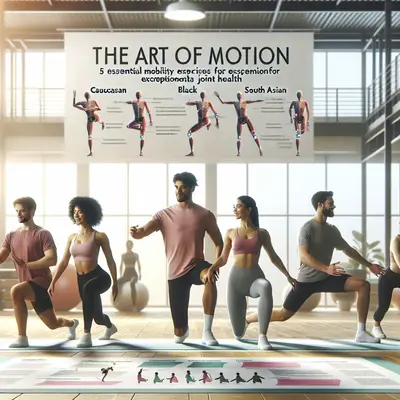
For many people, “mobility exercises” conjure images of rushed stretches tacked onto the end of a workout. At Joint Health Living, we see them differently: as a daily investment in ease, elegance, and long-term joint integrity. Mobility is not simply about touching your toes; it is about how gracefully you rise from a chair, how quietly your knees respond to the stairs, and how confidently you inhabit your own body as the years go by.
This is mobility as a lifestyle choice, not a chore. The following perspectives are designed for those who value longevity, subtle performance, and the quiet luxury of moving without negotiation. These five exclusive insights move beyond the usual “do these stretches” advice and into a more curated, strategic approach to joint health.
Insight 1: Treat Mobility as Joint “Skincare,” Not Workout Homework
Most people treat mobility like an afterthought—something to rush through when time allows. A more refined approach is to treat it the way you treat premium skincare: deliberate, consistent, and tailored to your unique needs. Just as you would not randomly apply products without understanding your skin, your joints deserve more than generic stretching routines pulled from a quick search.
Begin by identifying your “high-traffic” joints—the ones you rely on most in daily life, such as hips for walking and sitting, shoulders for carrying and reaching, and ankles for balance. Then, curate a short repertoire of 3–4 elegant, controlled movements for each. Think slow hip circles, gentle shoulder CARs (controlled articular rotations), and mindful ankle rolls, performed with attention to quality rather than quantity. Approaching mobility this way transforms it from an obligation into a ritual of maintenance, preserving the smooth “texture” of your movement much like a skincare ritual protects the texture of your complexion.
Insight 2: Precision Over Performance—Small Ranges, Impeccable Control
Traditional fitness culture often celebrates extremes: deeper squats, bigger stretches, and dramatic before-and-after transformations. Joint-focused mobility, however, rewards subtlety. The joints respond best not to aggressive pushing, but to precise, well-controlled exploration of the available range. Instead of asking, “How far can I go?” a more sophisticated question is, “How well can I move within what I currently have?”
One powerful refinement is to work in “micro-ranges”—small arcs of motion that you can control flawlessly, without wobbling, bracing, or holding your breath. For example, instead of sinking into the deepest lunge you can manage, try a shallower lunge where your front knee tracks cleanly, your hips feel stable, and you can move in and out of the position without strain. Over time, your nervous system learns that this range is safe, gradually allowing more freedom. This is less about spectacle and more about cultivating a quiet, reliable responsiveness in your joints—an understated but profound upgrade in everyday life.
Insight 3: The Hidden Power of Transitional Movements
Many mobility programs focus on static positions: hold this stretch, maintain that pose. Joint health, however, is built in the transitions—the moments when you move from floor to standing, from step to step, or from car seat to sidewalk. These transitions are where most “surprise” tweaks and discomforts arise, and they are often overlooked in conventional routines.
Integrating transitional drills into your day can be transformative. Practice rising from the floor with different strategies—using one hand, no hands, or with a deliberate, slow motion that keeps your joints aligned. Explore step-ups onto a low platform, paying attention to how your knee tracks over your toes and how your hip engages to support you. Even moving from sitting to standing can be turned into a refined mobility practice by emphasizing even weight distribution, controlled pacing, and a neutral spine. When you train transitions, you are conditioning your joints not just to exist in positions, but to navigate the real-world movements that define an independent and active life.
Insight 4: Joint Health Responds to Consistency, Not Intensity
The elegance of truly healthy joints lies not in what they can endure once, but in what they can do comfortably every single day. Intense, sporadic efforts are far less effective than modest, daily rituals that condition the tissues to adapt gradually. This is where a premium mindset toward movement makes a tangible difference: you are playing the long game, not chasing a quick impression.
A practical framework is to think in terms of “joint touchpoints” throughout the day—short, strategic mobility check-ins rather than a single, exhausting session. For example, you might do 2–3 minutes of ankle mobility before coffee, gentle hip rotations after prolonged sitting, and a brief shoulder sequence when you step away from your desk. Each session is intentionally light, almost effortless, but together they create a continuous message to your body: move well, move often, move without fear. Over months and years, this consistency builds resilience that cannot be replicated by occasional, high-effort sessions.
Insight 5: Pair Mobility With Strength for Truly “Quiet” Joints
Mobility without strength is like flexibility without support—visually impressive, but structurally fragile. For joints to feel truly “quiet” (no constant complaints, twinges, or hesitations), they need both range and the muscular capacity to control that range. The most refined joint-health programs blend mobility and strength so seamlessly that the line between them almost disappears.
You can apply this principle elegantly by adding light resistance or a controlled strength component to mobility drills. For instance, instead of simply circling your hips, hold a light weight at your chest and perform slow, supported hip hinges that both mobilize and strengthen. Replace passive hamstring stretches with slow Romanian deadlifts using very light resistance, focusing on smooth joint motion and muscular engagement rather than load. For shoulders, think of slow, intentional overhead reaches with a light band rather than static overhead stretching. The result is not just a joint that moves further, but a joint that feels uniquely confident and stable within that movement.
Conclusion
Mobility, when approached with intention and refinement, becomes much more than a “warm-up.” It is a daily commitment to preserving freedom, grace, and independence in how you move through the world. By treating mobility like joint skincare, emphasizing precision over performance, training transitions, prioritizing consistency, and pairing range with strength, you create a lifestyle of movement that feels both elevated and sustainable.
In a culture that often glorifies intensity and quick fixes, choosing this more considered path is a quiet act of luxury. Your reward is subtle yet unmistakable: joints that feel trustworthy, motion that feels effortless, and a body that supports the life you envision—today and for decades to come.
Key Takeaway
The most important thing to remember from this article is that this information can change how you think about Mobility Exercises.