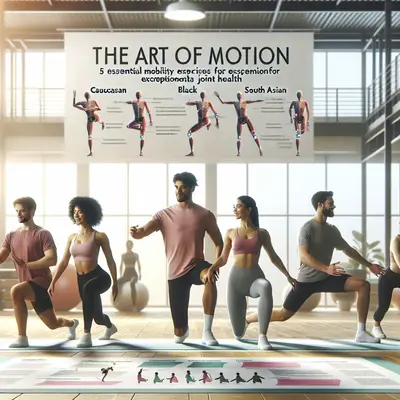
Mobility is often framed as rehab, correction, or obligation. At Joint Health Living, we regard it differently: as a quiet daily luxury—an investment in how gracefully you inhabit your body, both now and decades from now. Thoughtfully designed mobility work does more than “keep you loose.” It refines how your joints load, glide, and recover. It is the difference between merely moving and moving with intention, comfort, and confidence.
In this piece, we explore mobility exercises as a curated practice rather than a random collection of stretches—and share five exclusive, under-discussed insights for those serious about long-term joint health.
Mobility, Redefined: From Stretching to Joint Intelligence
Most people equate mobility with stretching, yet the two are not synonymous. Flexibility is your available range; mobility is how well you can control that range under load, through real-life movement. For joint health, control outranks passive looseness. A hyper-flexible but unstable joint is far more vulnerable than one with thoughtful, controlled range.
High-quality mobility training blends three elements: joint positioning, muscular engagement, and nervous system comfort. Each repetition sends a signal to your brain about what “safe” movement feels like, gradually reshaping how your body organizes motion. Over time, hips track more cleanly, shoulders rotate without pinching, and the spine distributes load more evenly. The aim is not circus-level contortions but quiet, repeatable, sustainable ease.
This is where intention matters more than intensity. A slow, well-sequenced hip rotation that respects joint alignment can do more for your long-term comfort than a dramatic split or forced deep stretch. When mobility is approached as joint education rather than punishment, the result is refined movement that feels both grounded and free.
The Architecture of an Elegant Mobility Session
Instead of racing through a few token stretches before a workout, consider designing your mobility as you would a well-structured meal: balanced, layered, and satisfying without excess. An elegant mobility session has a distinct architecture:
Begin with gentle circulation work: slow diaphragmatic breathing, light walking, or controlled arm swings to invite warmth into the tissues and signal safety to the nervous system. Move next into positional priming—placing key joints (hips, shoulders, spine, ankles) into clean, intentional shapes: half-kneeling hip openers, thoracic rotations, or supported deep squats.
From there, transition to controlled articular rotations—slow circles at each joint, moving only as far as you can without compensation. This helps maintain joint “maps” in the brain, preserving range and coordination. Finally, integrate your new range into simple functional patterns: split-stance reaches, step-downs with a deliberate heel-to-toe roll, or single-leg balance with arm sweeps.
The result is not just looser tissue, but a recalibrated movement system. You finish feeling taller, clearer, and more coordinated, rather than simply “stretched out.” That clarity is a hallmark of high-quality mobility work.
Exclusive Insight 1: Joint-Specific Mobility Ages Differently Than General Fitness
Cardio capacity and muscle strength can often be regained relatively quickly after a break. Joint-specific mobility does not behave as generously. Once you lose nuanced rotation in your hips or mid-back, or dorsiflexion at your ankles, reclaiming it can be painstaking. Subtle losses accumulate: a degree less rotation here, a few millimeters less glide there, until one day a basic lunge or stair descent feels strangely awkward.
This is why mobility for joint health must be treated as a non-negotiable baseline, not an occasional adjunct. Two or three brief sessions per week—focused on your most load-bearing joints (hips, knees, ankles, shoulders, and thoracic spine)—can substantially slow the “mobility drift” that often accompanies aging, sedentary work, or repetitive training.
The refined approach: schedule mobility as you would a standing meeting. Ten to fifteen minutes of dedicated joint time on specific days is more protective than sporadic 45-minute “guilt sessions.” Think of it as preserving the currency of your joints, so you never go into deficit.
Exclusive Insight 2: End-Range Control Is the Quiet Guardian of Your Cartilage
Most people explore the extremes of their joint range only under duress—reaching awkwardly, catching a fall, lifting something oddly placed. Yet cartilage health depends on periodic, well-controlled compression and decompression across the full, safe range of a joint. Like a sponge, cartilage relies on movement to draw in nutrients and flush out waste products.
End-range control drills—such as slow, active hip internal rotation in a seated position, or controlled overhead shoulder rotations lying on the floor—teach your joints to remain organized when they are most vulnerable. These are not glamorous exercises. They are small, precise, and often humbling. But they are powerful protectors of long-term joint resilience.
The refined detail: move just into the boundary of your comfortable range—where you sense resistance but no pain—and own that position with light muscular engagement and smooth breathing. Over time, that boundary recedes, and your joints gain a more robust “buffer” against life’s unexpected angles.
Exclusive Insight 3: The Nervous System, Not the Muscle, Is Often Your True Limiter
It is tempting to blame “tight muscles” for restricted movement. In reality, your nervous system is often the gatekeeper. Your brain uses tension as a protective strategy when it feels uncertain about a position or load. Simply forcing a muscle to lengthen without addressing this protective response can provoke more guarding or even pain.
Premium mobility practice pays close attention to nervous system tone. Incorporating slow nasal breathing, longer exhalations, and a deliberate pace tells your brain, “This is safe.” Poses and drills become invitations rather than demands. Over time, the nervous system grants access to deeper, more functional ranges of motion without the backlash of reactive tightness.
A sophisticated tactic: pair each mobility drill with a breath pattern. For example, enter a hip opener on an exhale, pause for two or three calm breaths while maintaining the position, and exit the pose as smoothly as you entered. The body learns that exploration does not equal threat, and range improves with less friction.
Exclusive Insight 4: Micro-Mobility Within Your Day Outperforms Occasional Marathons
For people serious about joint health, the most impactful mobility practice is rarely the heroic weekend session. It is the micro-adjustments sprinkled throughout the day that dissolve stiffness before it becomes structure. Modern life, with its sitting, screens, and repetitive patterns, continuously “molds” your joints into specific shapes. Without counter-movements, those shapes start to harden.
Micro-mobility might look like: two minutes of ankle circles and calf raises while you wait for your coffee; a single set of slow, controlled neck rotations between video calls; a brief deep squat hold, using a countertop for support, before dinner. These low-friction habits introduce variety into your joint loading patterns, giving your tissues different lines of stress and your nervous system fresh movement information.
The refined approach is not doing more, but doing sooner and smaller. Address the first whisper of stiffness rather than its eventual shout. Over months and years, these tiny interventions create a body that never strays too far from comfortable, capable movement.
Exclusive Insight 5: Symmetry Is Overrated—Intelligent Asymmetry Is the Goal
Many people chase perfect left-right symmetry as the ultimate sign of joint health. Yet human bodies are inherently asymmetrical—structurally, neurologically, and functionally. Forcing absolute symmetry can sometimes ignore meaningful differences in history, injury, and lifestyle between your left and right sides.
An elevated mobility practice views asymmetry not as a flaw but as data. If one hip rotates less, or one shoulder feels less stable overhead, that side simply needs more curated attention. Rather than making both sides do the same volume and intensity, you quietly bias your training: an extra set on the limited side, a slightly longer hold, or a more supported version of a drill to build confidence.
The goal is not mirror-image perfection, but intelligent asymmetry: both sides robust enough to handle your real world, even if they do so in slightly different ways. This perspective reduces frustration and supports more nuanced, personalized joint care—hallmarks of a truly premium health strategy.
Bringing It Together: Crafting Your Personal Mobility Ritual
Transforming mobility from an afterthought into a daily luxury does not require elaborate routines or equipment. It requires curation. Start by choosing three to five movements that feel distinctly beneficial for your joints—perhaps hip CARs (controlled articular rotations), a thoracic spine rotation, a supported deep squat, ankle dorsiflexion work, and gentle neck rotations.
Perform them several times per week with calm breathing and deliberate attention to alignment, tension, and sensation. Protect your end ranges with control, use micro-sessions to disrupt stiffness throughout the day, and view asymmetries as a guide rather than a flaw. Over time, your joints will respond with a newfound clarity of motion—a sense that your body is not merely enduring life’s demands, but meeting them with quiet, poised capability.
Mobility, practiced this way, becomes less about “fixing” your body and more about refining how you live inside it. That refinement is not loud, but it is unmistakably powerful.
Sources
- Harvard Health Publishing – Stretching: Focus on Flexibility – Overview of flexibility and mobility concepts, with guidance on safe range-of-motion work
- Mayo Clinic – Exercise and arthritis – Explains how regular, controlled movement can protect joints and improve pain and function in arthritis
- Johns Hopkins Medicine – Joint Health & Mobility – Discusses the importance of consistent, appropriate joint movement for long-term health
- NIH / MedlinePlus – Cartilage Disorders – Describes cartilage structure and how movement and load influence joint cartilage health
- Cleveland Clinic – Range of Motion Exercises – Details the role of range-of-motion work in maintaining joint function and preventing stiffness
Key Takeaway
The most important thing to remember from this article is that this information can change how you think about Mobility Exercises.