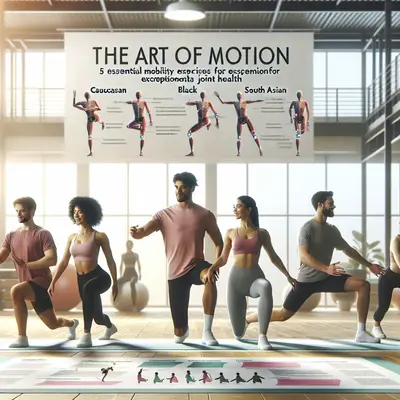
Mobility is often treated as an afterthought—something to be reclaimed only when it’s already diminished. Yet for discerning, health-conscious adults, joint mobility is a quiet luxury: it shapes how gracefully you rise from a chair, how easily you turn your head when driving, how confidently you move through a long day. This is not about “working out harder”; it’s about cultivating fluid, intelligent movement so your joints age elegantly with you.
Below, you’ll find a refined perspective on mobility training—five exclusive insights that go beyond generic stretches and quick fixes, designed for those who expect their bodies to feel as composed as their lifestyles look.
Mobility as Joint “Skincare”: Small, Daily, Layered
Think of mobility the way you think of a premium skincare routine: its magic lies in consistent, subtle layering rather than dramatic, once-a-week overhauls. Joints respond extraordinarily well to frequent, low-dose movement that circulates synovial fluid (your joints’ natural lubricant), nourishes cartilage, and maintains the health of surrounding tissues.
Instead of dedicating one long “mobility day,” integrate 3–7 minutes of focused joint work into transition points you already have: immediately after brushing your teeth, before your first email, while your evening tea steeps. For example, perform gentle neck rotations (chin tracing a small circle), slow shoulder rolls, and deliberate ankle circles in both directions. The objective is not intensity, but precision: smooth arcs, comfortable ranges, and controlled breathing.
This micro-dosing approach is especially protective for weight-bearing joints (hips, knees, ankles), which benefit from frequent, pressure-changing movement to keep cartilage well-nourished. Like a well-formulated serum, the benefits are cumulative: it is the quiet repetition that preserves a sense of lightness in your body over the years.
Range with Control: The “Strength Envelope” Principle
Most mobility routines chase flexibility—getting “further” into a stretch. For joint longevity, the more sophisticated goal is controlled range: only moving as far as you can actively support with strength. This is your “strength envelope,” and preserving it is one of the most joint-intelligent decisions you can make.
When you explore a new mobility exercise—say, a deep hip hinge or a rotational lunge—pause where your body begins to lose stability or control. Instead of passively holding the furthest point, gently pull yourself into that position using your muscles. For example, in a seated hamstring stretch, lightly press your heel into the floor for a few seconds, then try to draw your thigh closer using your hip flexors rather than your hands.
This style of training, often called “active mobility,” teaches your nervous system that new ranges of motion are safe and supported. It reduces the risk of overstretching ligaments and gives your joints what they truly crave: muscles that can guide and guard them throughout the full arc of movement. Over time, your flexibility increases—but always within a secure, strength-backed envelope.
The Forgotten Axis: Rotational Mobility as a Mark of Sophistication
Most people move primarily forward and backward: squats, walking, cycling, treadmills. But joints are designed to rotate and glide in multiple planes. When rotation is ignored, stiffness builds in subtle ways—neck tightness when checking a blind spot, hip discomfort when turning to step out of a car, lower back tension when twisting to reach a shelf.
Elevating your mobility practice means deliberately training rotation with smooth, low-friction movement:
- Neck and upper spine: Seated, cross arms over your chest and gently rotate your torso to the right, pause, then to the left, keeping the motion pain-free and unhurried.
- Hips: In a comfortable chair, cross one ankle over the opposite knee, then gently rotate the lifted leg inward and outward at the hip, as though you’re polishing a small sphere in the joint.
- Ankles: Draw slow, controlled circles with your feet, focusing on making the circle as round and steady as possible.
Rotational mobility helps distribute load more evenly across joint surfaces, which is particularly relevant for those mindful of arthritis risk or early joint changes. It also refines coordination: your body feels less “blocky” and more like a well-engineered system, where every movement transitions smoothly into the next.
Frictionless Transitions: Mobility Between Postures, Not Just in Poses
Conventional stretching focuses on static positions—hold this, then move to that. But daily life is lived in transitions: rising from the floor, gliding from sitting to standing, descending stairs, turning while carrying a bag. If these moments feel clumsy or effortful, your joints are signaling a need for more intelligent, dynamic mobility.
A more elevated mobility approach emphasizes how you move between postures:
- Chair to stand as a mobility exercise: Instead of pushing off with your hands, position your feet slightly behind your knees. Lean your torso forward, imagine “unfolding” your hips while keeping your spine long, and stand up in one smooth exhale. Reverse the motion with equal control when you sit back down.
- Lunge to stand: From a gentle lunge position (using a wall or countertop for balance if needed), practice stepping back to standing and then returning to the lunge, focusing on the tracking of the knee over the foot, the glide of the hip, and the evenness of your weight distribution.
Pay attention to tempo—neither rushed nor sluggish, but deliberate. This “transition training” fortifies the stabilizing muscles around your joints, reduces the chance of awkward, jarring movements, and makes daily motion feel quietly athletic, even if your day is spent in a boardroom rather than a gym.
Nervous System Elegance: Breathing as a Joint-Protection Tool
One of the more discreet yet powerful levers for better mobility is your nervous system. When the body perceives threat—time pressure, pain, or even mental stress—it tends to tighten muscles around joints as a protective reflex. Operating mobility drills in this state is like stretching while your internal brakes are on: limited, uncomfortable, and occasionally risky.
Transform your mobility practice into a calming ritual by pairing each movement with intentional breathing:
- Inhale through your nose as you prepare or return to the neutral position.
- Exhale slowly (ideally through slightly pursed lips) as you move into a more lengthened or rotated position.
- Pause briefly at the end of the exhale and notice if your body offers a gentle, almost imperceptible increase in range without force.
This breathing-led approach signals safety to your nervous system, allowing muscles to soften their grip and joints to access more organic mobility. It also keeps your attention anchored in the present, turning a simple hip or shoulder drill into a brief, grounding practice—a subtle luxury in a life that’s likely rich in responsibilities and demands.
Conclusion
Mobility work, at its most refined, is not about acrobatics or extremes—it is about precision, continuity, and respect for the architecture of your joints. By treating mobility like high-end maintenance rather than crisis management, you create a body that moves with quiet confidence: hips that rotate without complaint, knees that track with grace, a spine that turns and lengthens as though the years have been kind.
These five insights—daily micro-dosing, strength-backed ranges, rotational nuance, frictionless transitions, and nervous-system-aware breathing—form a sophisticated framework for joint care. They require no elaborate equipment and little time, only a decision to move with intention. Over months and years, that decision becomes visible: not in dramatic before-and-after photos, but in the understated elegance of how you inhabit your own body.
Sources
- [Harvard Health Publishing – Why stretching is important](https://www.health.harvard.edu/staying-healthy/why-stretching-is-important) – Overview of flexibility, mobility, and their role in healthy movement
- [Arthritis Foundation – Range-of-Motion Exercises](https://www.arthritis.org/health-wellness/healthy-living/physical-activity/stretching-range-of-motion/range-of-motion-exercises) – Practical guidance on joint-safe mobility work, especially for those with arthritis concerns
- [Cleveland Clinic – Joint Health: How to Keep Your Joints Healthy](https://health.clevelandclinic.org/joint-health-tips) – Evidence-based tips on preserving joint function and reducing wear over time
- [NIH – Physical Activity and Your Heart](https://www.nhlbi.nih.gov/health/physical-activity-and-your-heart) – Discusses how regular movement and controlled activity support overall musculoskeletal and cardiovascular health
- [Mayo Clinic – Exercising with Arthritis: Improve Your Joint Pain and Stiffness](https://www.mayoclinic.org/diseases-conditions/arthritis/in-depth/arthritis/art-20047971) – Explains how exercise and gentle mobility can be tailored to protect joints and manage stiffness
Key Takeaway
The most important thing to remember from this article is that this information can change how you think about Mobility Exercises.