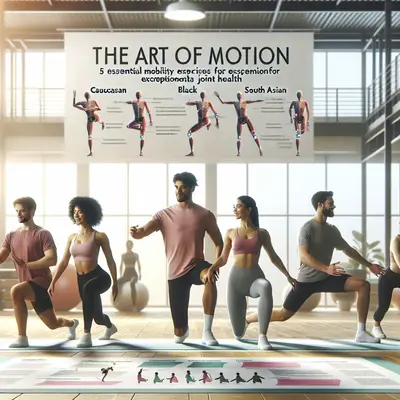
The most elegant bodies rarely move the most—they move the best. For those who care deeply about joint health, mobility work is not a warm-up or an afterthought; it is a daily signature, as distinctive as the way you write your name. This is not about athletic bravado or extreme flexibility. It is about creating a quiet, enduring power in your joints so that walking stairs, turning your neck, or rising from the floor remain beautifully effortless—well into the decades ahead.
Below, you’ll find a refined exploration of mobility exercises designed for people who expect more from their bodies: more ease, more longevity, and more control. Woven through are five exclusive insights that can transform mobility from “something you should do” into a non‑negotiable ritual of joint preservation.
Mobility, Redefined: Why Joints Crave Movement with Intention
Most people treat mobility as something to “get through” before the real workout. Yet for joints, mobility is the main event. Mobility training blends flexibility (how far a joint can move) with control (how well you can own every degree of that motion). When executed with intention, mobility work drives synovial fluid through the joint, nourishes cartilage, and helps maintain the resilience of ligaments and tendons.
Slow, deliberate mobility exercises also feed your nervous system with high-quality information. As you practice controlled circles, rotations, and gentle end-range holds, the brain sharpens its map of your joints—improving balance, coordination, and stability. The result is a body that doesn’t just move far, but moves wisely.
Exclusive Insight #1: Joint-specific mobility is more protective than “general stretching.”
Many routines focus on broad stretches—hamstrings, hip flexors, chest. For long-term joint health, it is far more powerful to target each joint directly: the ankle, the hip socket, the shoulder capsule, the individual vertebrae of the spine. Cartilage is avascular—meaning it doesn’t have its own blood supply—and depends on compression and decompression inside each specific joint to stay nourished. A refined mobility practice treats your joints one by one, like individual pieces in a finely tuned mechanism, not just regions on a muscle chart.
The Morning Audit: A Five-Minute Scan of Your Joints
The most effective mobility practice is the one you actually do—every day. A brief, structured “joint audit” each morning creates a baseline: What feels smooth? What feels stiff? Where is your range today?
Set aside five minutes and move methodically from head to toe:
- Gentle neck rotations and nods
- Slow shoulder circles, both forward and backward
- Elbow bends and forearm rotations
- Wrist circles and finger spreads
- Ribcage rotations and side-bending
- Hip circles in standing or on all fours
- Knee bends and controlled small circles
- Ankle circles and toe curls
Each movement should be unhurried, smooth, and pain-free. Your role is to observe: Is the left side more restricted? Is one direction grittier or tighter? Over time, these daily observations become an early warning system, often revealing subtle joint changes long before they become a problem.
Exclusive Insight #2: Consistency outranks intensity for joint longevity.
From a joint-health perspective, five minutes of daily, low-intensity mobility is more protective than sporadic, intense stretching sessions. Cartilage and connective tissue respond best to frequent, modest doses of movement that gently compress and release the joint surfaces. This rhythm is what maintains lubrication, diffusion of nutrients, and a sense of ease. Think of mobility as the “toothbrushing” of your joints—effective because it happens regularly, not because it is dramatic.
End-Range Strength: Where True Joint Confidence Lives
Most people train strength in the middle of their range of motion, where things feel easiest and safest. But joints are often injured at the edges—when you reach a little farther, twist a bit deeper, or lose balance at an awkward angle. One of the most sophisticated forms of mobility work is “end-range strength”: building control where your movement nearly stops.
For example:
- At the top of a shoulder circle, pause at your highest reachable point and gently hold for 5–10 seconds, lightly tensing the surrounding muscles.
- At the outer edge of a hip circle, maintain the position and apply a subtle, controlled contraction, as if you are “owning” that final inch rather than collapsing into it.
- In a deep but comfortable squat, hold the position and actively push the floor apart with your feet, keeping the knees aligned over the toes and the chest softly lifted.
This controlled, low-intensity loading at your joint’s safer end ranges stimulates the tissues that stabilize the joint and trains the brain that this position is not a threat. Over time, the joint becomes not only more mobile, but more trustworthy.
Exclusive Insight #3: Passive flexibility without strength can quietly destabilize joints.
It may feel luxurious to sink into deep stretches, but if you regularly move into large ranges you cannot control, you may be asking your ligaments and joint capsules to do the work that muscles should do. For someone invested in joint longevity, the goal is not maximum flexibility—it is usable range. Elegant mobility means you can enter a position, hold it, and exit it under your own muscular control. This approach is especially important for hypermobile individuals, who often benefit more from strengthening their available range than expanding it.
The Art of Smooth Rotation: Preserving the “Twist” in Your Body
Rotation is one of the first movement qualities to fade with age and pain. Stiff necks, locked mid-backs, rigid hips—all of these quietly limit rotational freedom. Yet rotation is crucial: you need it to look behind you while driving, to walk with a natural arm swing, to protect your lower back during everyday bending and lifting.
Curated rotational mobility work focuses on the spine, shoulders, and hips:
- Spinal rotations in sitting or side-lying: Keeping the pelvis steady, rotate slowly through the ribs and upper back, reaching only as far as feels smooth and repeatable.
- Hip internal and external rotation: In seated or lying positions, gently roll the thigh inward and outward, keeping movement slow and pain-free.
- Shoulder rotational control: With elbow by your side at 90 degrees, rotate the forearm outward and inward as far as you can while maintaining neutral posture and no compensations.
As you refine these rotations, focus less on “how far” and more on “how clean.” Your goal is motion that is unforced, quiet in the joints, and balanced side to side.
Exclusive Insight #4: Rotational mobility is a hidden ally against compensatory back and knee pain.
When the hips and mid-back lose rotational capacity, the lower back and knees often pick up the slack, twisting in ways they were not designed to. By restoring even modest, controlled rotation in the hips and thoracic spine, you distribute forces more intelligently throughout the body. For people with persistent low back discomfort or knee sensitivity, targeted rotational work can reduce the need for those joints to act as substitute rotators—quietly easing strain without aggressive stretching or high-impact exercise.
Micro-Mobility: Integrating Joint Care into a Busy, Ambitious Life
Luxury, in many ways, is the ability to care for your health without sacrificing your time. The most effective mobility practices are not necessarily long; they are woven seamlessly into your existing rhythm.
Consider these micro-mobility strategies throughout the day:
- While waiting for the kettle: gentle ankle circles and calf raises, keeping the joints aligned and movement slow.
- Between video calls: 60 seconds of neck and shoulder rotations, standing with tall posture and soft jaw.
- After prolonged sitting: hip circles, gentle lunges, or “figure-4” hip mobility, performed with deliberate breathing.
- Before bed: a brief sequence of spinal rotations in lying, followed by controlled knee and hip movements to signal relaxation to the nervous system.
You are not “fitting in” exercise; you are upgrading how you inhabit your body moment to moment. This subtle integration creates a baseline of fluidity that formal workouts can then elevate further.
Exclusive Insight #5: Your nervous system—not just your joints—decides how far you can move.
Many mobility limitations are “software” issues, not merely “hardware” problems. The brain restricts range when it senses instability, fatigue, or threat. When mobility work is approached with calm breathing, slow tempo, and an absence of forcing, the nervous system is more willing to allow new range. Techniques such as gentle isometric holds at the end of your range, followed by slow breathing and a measured return to neutral, send a powerful signal of safety. Over weeks, your available motion often increases—not because you forced the joint, but because you earned the brain’s trust.
Conclusion
A sophisticated approach to mobility is not about performing elaborate routines or chasing impressive positions. It is about cultivating a daily relationship with your joints: listening, refining, and gently expanding what they can do with confidence.
By prioritizing joint-specific mobility, favoring consistency over intensity, strengthening your end ranges, restoring rotation, and respecting the role of your nervous system, you create a quiet resilience that is difficult to see—but impossible to ignore. The payoff is elegantly simple: stairs that feel lighter, walks that feel smoother, and a body that moves as though it has been carefully maintained for years—because it has.
Sources
- Harvard Health Publishing – Stretching and flexibility: How to maintain joint health – Overview of flexibility and joint-friendly approaches to movement
- Arthritis Foundation – Range-of-Motion Exercises – Practical guidance on range-of-motion work for joint preservation
- Hospital for Special Surgery (HSS) – The Benefits of Mobility Training – Explains why mobility is distinct from stretching and its role in joint health
- Mayo Clinic – Exercise and arthritis – Evidence-based recommendations on safe movement for arthritic joints
- Cleveland Clinic – Synovial Joints and Cartilage Health – Discusses how synovial joints function and why movement supports cartilage nutrition
Key Takeaway
The most important thing to remember from this article is that this information can change how you think about Mobility Exercises.