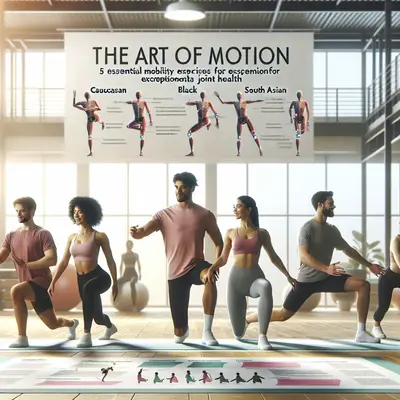
Joint health is often framed as a crisis to be managed later. In reality, it can be cultivated as a daily luxury now—a quiet, deliberate practice that keeps your body supple, responsive, and deeply capable. Mobility exercises are not simply stretches; they are intelligent, joint‑focused movements that refine how your body ages. Think of them as the backstage work that lets you move through life with understated ease.
This guide explores mobility training with a focus on refinement, not exhaustion—plus five exclusive insights that those serious about joint health rarely see in mainstream advice.
Mobility, Defined for the Joint-Conscious
Mobility is the ability to move a joint smoothly through its full, comfortable range of motion while maintaining control, strength, and stability. It marries flexibility (length of tissue) with strength (control of that range) and coordination (how the body organizes movement). Where traditional stretching often focuses on passively “pulling” muscles longer, mobility work actively teaches your joints to own their range—especially the “end ranges” that tend to stiffen with age or inactivity.
For joint‑focused individuals, this distinction matters. Controlled, purposeful mobility training nourishes cartilage by encouraging the flow of synovial fluid, supports ligaments and tendons through gentle loading, and helps surrounding muscles share the workload more evenly. Over time, this can translate into fewer flare‑ups, more resilient joints, and a greater sense of confidence in everyday movement—from climbing stairs in heels to lowering into a deep garden squat. Mobility is not about becoming acrobatic; it is about preserving functional elegance.
Exclusive Insight #1: Your Joints Respond to “Micro‑Luxury,” Not Occasional Overhaul
Most people treat mobility as a corrective—something to do only when discomfort appears. Joints, however, respond far better to what can be called micro‑luxury: brief, frequent, deliberate sessions that feel more like maintenance than punishment. Just 5–10 minutes of focused mobility, repeated once or twice per day, often yields more benefit than a single weekly “marathon” stretch session.
The physiology supports this. Cartilage has no direct blood supply; it relies on the gentle compression and decompression of movement to receive nutrients via synovial fluid. Frequent, light motion is the equivalent of excellent daily skincare for your joints—subtle, consistent, and cumulative. A quiet morning routine of ankle circles, hip cars (controlled articular rotations), and gentle thoracic (upper‑back) opening can do more for joint longevity than sporadic, intense efforts that leave tissues irritated. For joint health, consistency is the most underrated luxury.
Exclusive Insight #2: End‑Range Control Is Your Hidden Joint Insurance
Most routines focus on the middle of a joint’s range: the comfortable, familiar territory. Yet injuries and stiffness often emerge at the extremes—where a shoulder reaches overhead, a hip drops into a deeper lunge, or an ankle rolls unexpectedly on uneven ground. Training end‑range control—gently strengthening the last 10–20% of your movement—acts like premium insurance for your joints.
This does not mean forcing yourself into deep positions. Instead, you take your joint to a safe, near‑end range and apply low‑intensity, isometric strength there. For example, in a deep but comfortable lunge, you might lightly press your front knee outward against your hand, then inward, teaching the hip and knee to stabilize at that depth. With time, these end‑range drills train the nervous system to trust those positions. The result is not only greater flexibility, but stability where it matters most, reducing the risk of sudden “tweaks” when life demands more from your joints than your routine typically does.
Exclusive Insight #3: Mobility Is a Conversation Between Breath and Joints
Mobility is often treated as purely mechanical—move, stretch, repeat. Yet your nervous system is the true gatekeeper of range of motion. When your body perceives threat—through pain, stress, or even shallow breathing—it restricts movement as a protective response. Elegant joint care, therefore, integrates breath as a central tool, not an afterthought.
Slow, diaphragmatic breathing during mobility work signals safety to the nervous system, allowing muscles to release unnecessary tension and joints to explore a slightly greater range. For example, in a gentle hip opener, you might inhale for four counts as you ease toward the stretch, then exhale for six to eight counts as you stay there, letting the exhale length guide your body into deeper relaxation without forcing it. Over time, your brain “recalibrates” what it considers safe, expanding your usable range. This interplay between breath and movement creates a mobility practice that feels restorative rather than confrontational—more akin to a moving meditation than a chore.
Exclusive Insight #4: Joint Health Depends on Movement Texture, Not Just Time
It is common advice to “move more,” but for joints, the texture of movement is as important as the quantity. Daily life tends to be dominated by a narrow set of patterns: sitting, standing, walking a flat surface, reaching forward. These repetitive, predictable motions can leave certain joint angles overused and others neglected, creating pockets of stiffness and vulnerability.
A refined mobility practice introduces variation—rotation, diagonal patterns, gentle side bending, controlled spirals. For instance, instead of only walking in a straight line, you might incorporate lateral steps, backward steps, and soft pivots in your warm‑up, or explore gentle spinal rotations while seated. Even your wrists and fingers benefit from this variety—think slow, full‑range wrist circles and individual finger mobilizations for those who type extensively. By diversifying how your joints move, you distribute load more evenly, reduce localized wear, and cultivate a body that feels adaptable rather than fragile. It is the difference between a well‑used but beautifully maintained leather bag and one that has been folded in the same way for years.
Exclusive Insight #5: The Floor Is an Advanced, Underused Mobility Tool
Many joint‑conscious individuals avoid the floor entirely, assuming it to be too demanding or inelegant. In truth, the floor is one of the most sophisticated tools for preserving joint mobility—especially in the hips, knees, ankles, and spine—when used thoughtfully. Regularly getting down to and up from the floor is strongly associated with functional independence as we age, and it can be trained gracefully, not aggressively.
Simple floor transitions—such as moving from standing to a half‑kneel, then to a seated position, and back again—ask your joints to coordinate through multiple ranges of motion. Seated floor positions like a supported cross‑legged sit, a gentle 90‑90 hip position, or a side‑sit encourage the hips and ankles to access angles rarely reached in chairs. With cushions, yoga blocks, or low benches for support, these shapes can be made comfortable and accessible. Over time, the floor becomes less an obstacle and more a proving ground for quiet strength and mobility—one of the most direct ways to preserve autonomy in daily life.
Curating a Daily Mobility Ritual for Joint Longevity
To integrate mobility into a refined lifestyle, think in terms of ritual rather than workout. Your daily practice can be brief but intentional: perhaps a 10‑minute “mobility espresso” in the morning and a 5‑minute decompression in the evening. Begin with the large, load‑bearing joints—the hips, knees, and ankles—then invite in the spine and shoulders. For each area, choose one or two movements that explore controlled range, gentle rotation, and end‑range strength.
For example, a morning sequence might include ankle circles while standing at the kitchen counter, controlled hip rotations while holding onto a chair for balance, a slow cat‑cow for the spine, and a few shoulder circles with intentional breath. In the evening, you might favor floor‑based positions: a 90‑90 hip sit with small torso rotations, gentle thoracic twists, and diaphragmatic breathing. The key is not exhaustion, but freshness—each session should leave your joints feeling more awake, not depleted. Over weeks and months, this understated consistency becomes one of the most powerful investments you can make in how gracefully your body moves through time.
Conclusion
Mobility training, approached with care and intelligence, is less about “fixing” joints and more about honoring them. It transforms movement from something you push through into something you curate: micro‑luxury moments, end‑range confidence, breath‑led expansion, diverse movement textures, and an elegant relationship with the floor. When mobility becomes part of your daily aesthetic—quietly woven into how you begin and end the day—your joints are no longer an afterthought. They become partners in a life lived with ease, poise, and enduring capability.
Sources
- [Harvard Health Publishing – Stretching and Flexibility](https://www.health.harvard.edu/staying-healthy/the-importance-of-stretching) - Explains the benefits of regular stretching and mobility for joint health and function
- [Arthritis Foundation – Range-of-Motion Exercises](https://www.arthritis.org/health-wellness/healthy-living/physical-activity/stretching/benefits-of-range-of-motion-exercises) - Details why gentle, frequent range-of-motion exercises support arthritic and aging joints
- [NIH – Physical Activity and Your Heart](https://www.nhlbi.nih.gov/health/heart-healthy-living/physical-activity) - Discusses how consistent movement benefits overall musculoskeletal and cardiovascular health
- [Cleveland Clinic – Synovial Joints](https://my.clevelandclinic.org/health/body/24490-synovial-joints) - Provides an overview of joint structures, synovial fluid, and how movement nourishes cartilage
- [Mayo Clinic – Exercise: How to Get Started Safely](https://www.mayoclinic.org/healthy-lifestyle/fitness/in-depth/exercise/art-20045506) - Offers guidance on starting and progressing exercise routines, including joint‑safe strategies
Key Takeaway
The most important thing to remember from this article is that this information can change how you think about Mobility Exercises.