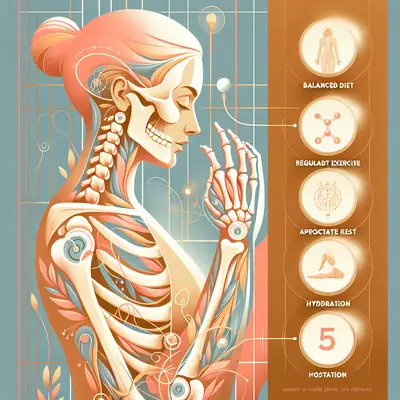
Healthy living is often reduced to slogans and step counts. For those who care deeply about the quality of their movement—not just its quantity—this is not enough. A truly elevated approach to health treats your joints as heirloom pieces: worth protecting, thoughtfully maintained, and central to how you inhabit your life. This is not about perfection, but about cultivating an environment—physical, nutritional, and emotional—where your joints are quietly supported in everything you do.
Below are five exclusive, less-obvious insights crafted for people who regard joint health as a long-term, high-value investment rather than a short-term fix.
1. Train Your Nervous System Before You Train Your Joints
Many joint-focused plans jump straight into strengthening, stretching, and “fixing.” Yet your nervous system is the conductor behind every movement. When it is overloaded—by stress, lack of sleep, or constant rushing—your muscles guard, your joints stiffen, and your perception of pain heightens.
Begin with regulation rather than exertion. Simple, deliberate practices can “downshift” the nervous system and create a calmer baseline for movement: slow nasal breathing before exercise, a brief body-scan while seated, or five minutes of quiet decompression between work and workouts. When your nervous system feels safe, muscles coordinate more efficiently and joints experience less chaotic force.
This shift is subtle but profound: you are not just strengthening tissue; you are cultivating a calmer operating system in which your joints can move more freely and with less perceived threat.
2. Elevate Everyday Micro-Movements, Not Just Formal Workouts
Most conversations about joint health focus on scheduled workouts: the exercise class, the Pilates session, the gym routine. But your joints are influenced far more by the thousands of “micro-movements” that happen between these formal sessions—how you reach for a book, stand in a queue, slide into a car, or rise from a chair.
A refined approach is to upgrade these micro-movements with intention:
- Gently press through the whole foot when standing up, instead of pushing from your toes or pulling from your lower back.
- When reaching overhead, soften your ribs, let your shoulder blade glide, and avoid jutting your head forward.
- While brushing your teeth, balance on one leg for a few seconds (lightly holding the counter if needed), then switch—this builds hip stability quietly, without adding “another workout.”
These marginal refinements are where premium joint care lives: not in dramatic efforts, but in consistently choosing more elegant mechanics in everyday life. Over months and years, this “micro-movement upgrade” can be as influential as any formal training plan.
3. Curate an Anti-Inflammatory Lifestyle, Not Just an Anti-Inflammatory Diet
It is well-known that nutrition influences inflammation, and thus joint comfort. Yet an elevated strategy looks beyond the plate and recognizes lifestyle as a full-spectrum anti-inflammatory tool.
Nutrition remains essential—favoring colorful vegetables, omega-3–rich foods (like salmon, sardines, walnuts, and flax), and minimizing ultra-processed options—but consider the additional, often overlooked levers:
- Sleep quality: Deep, consistent sleep supports tissue repair and regulates inflammatory pathways.
- Emotional load: Chronic psychological stress activates hormonal and immune responses that can amplify joint discomfort, even when diet is exemplary.
- Light exposure: Natural daylight helps regulate circadian rhythms, indirectly influencing pain sensitivity, energy, and tissue recovery.
- Movement variability: Gentle variety in movement patterns nourishes cartilage and prevents the “hot spots” that arise when joints are used in the same way, all day, every day.
Instead of obsessing over a perfect meal plan, think like a curator: arrange your days to minimize unnecessary inflammatory triggers, both physical and emotional. Your joints benefit from the sum of these influences, not just what appears on your plate.
4. Treat Muscle Strength as Joint Jewelry—Subtle, Supportive, and Essential
For joints, muscle is not bulk; it is architecture. Think of strength as finely crafted scaffolding that discreetly supports every step, sit, and twist. Underdeveloped or imbalanced strength forces joints to take on loads they are not meant to manage alone; overzealous or poorly directed strength work can compress or irritate them.
A sophisticated strength strategy for joint health has three signature qualities:
- Tempered intensity: You train “challenged but in control,” not in collapse or grimace. Joints should feel more stable after a session, not agitated.
- Deliberate tempo: Controlled lowering (the eccentric phase) develops strength where joints often need it most—during deceleration and landing, such as going downstairs or catching yourself from a trip.
- Regional thinking: Instead of fixating on the sore area, you strengthen the neighborhoods around it. For example, hip and core strength for knees, upper back and shoulder blade strength for shoulders, glute and calf strength for ankles.
Over time, this approach turns strength into quiet luxury for your joints: rarely ostentatious, always supportive, and deeply protective when life becomes physically demanding.
5. Make Recovery a Daily Ritual, Not an Emergency Response
Many people treat recovery as an emergency protocol—activated only when pain spikes or fatigue becomes unavoidable. A more refined standard is to embed recovery into the architecture of each day so that your joints are consistently restored rather than periodically rescued.
Consider integrating understated, repeatable rituals:
- Short, scheduled “un-crumpling” sessions: Two or three times per day, take 2–3 minutes to gently move your major joints through comfortable ranges—neck, shoulders, hips, knees, and ankles. No stretching to the edge, just moisturizing your movement.
- Quiet contact: Using a soft ball or your fingertips, lightly massage around—not directly on—the most burdened joints (for example, the muscles beside the kneecap rather than the kneecap itself). This can reduce tension and improve circulation.
- Temperature as a tool: Alternating brief warmth and coolness on frequently used joints (such as hands or knees) can support comfort and ease after long days at a desk or on your feet.
By ritualizing recovery, you send your body a consistent message: your joints are not negotiable, last-minute considerations—they are central assets worth deliberate care every single day.
Conclusion
Healthy living, at its most refined, is not a punishing regimen but a quiet refinement of choices. When you organize your life around calm nervous system function, elevated micro-movements, an anti-inflammatory lifestyle, intelligent strength, and daily recovery rituals, your joints are no longer afterthoughts. They become honored participants in a more graceful way of living.
The goal is not to chase an ideal, but to cultivate a standard: a life where each movement—even the smallest—reflects respect for the structures that carry you through it. Over months and years, that respect becomes resilience, and resilience becomes freedom.
Sources
- NIH: Joint Health and Aging - Overview of how joints change with age and evidence-based strategies to manage osteoarthritis
- Harvard Health Publishing – The Anti-Inflammatory Diet - Explores the role of diet and inflammation, including its impact on joint health
- Arthritis Foundation – Physical Activity and Joint Health - Guidance on how movement and exercise support joint comfort and function
- Cleveland Clinic – The Importance of Sleep for Pain and Inflammation - Explains the connection between sleep, inflammation, and pain perception
- Mayo Clinic – Strength Training: Health Benefits - Details how strength training supports long-term musculoskeletal and joint health
Key Takeaway
The most important thing to remember from this article is that this information can change how you think about Healthy Living.