Mobility is no longer the domain of athletes alone; it has become the quiet luxury of those who wish to move through life with elegance, ease, and authority over their own bodies. For discerning individuals who value longevity as much as lifestyle, mobility exercises are not “workouts” in the traditional sense—they are daily investments in the architecture of joint health. This is an atelier approach to movement: intentional, refined, and exquisitely precise.
Below are five exclusive insights that elevate mobility from a generic fitness trend into a sophisticated practice worthy of your time and attention.
Mobility as Joint Nutrition in Motion
Most people treat mobility as stretching’s less glamorous cousin, something to be tacked on at the end of a workout. In reality, high-quality mobility work functions like nutrition delivered through movement—feeding cartilage, ligaments, and tendons with exactly what they need to remain resilient.
When you move a joint slowly and deliberately through its full, pain-free range of motion, you help circulate synovial fluid, the joint’s natural lubricant. This fluid carries oxygen and nutrients to cartilage, which has no direct blood supply of its own. That means rotations of your hips, wrists, shoulders, and ankles—done consistently—are not trivial gestures; they are how you “water” the living tissue that allows you to turn your head, rise from a chair, or descend stairs with composure.
Think of a daily mobility ritual as the biomechanical equivalent of a premium skincare routine: small, meticulous actions that compound over time into visible, tangible results. Just as neglect shows on the skin, absence of mobility work eventually reveals itself in stiffness, hesitation, and discomfort around the joints.
The Elegance of Controlled Range: Training the Edges, Not the Extremes
The most sophisticated mobility routines do not chase circus-level flexibility or contortionist ranges. Instead, they focus on controlled, high-quality movement near the outer boundaries of what your joints can comfortably do. This is where most joint longevity is won or lost.
Controlled articular rotations (slow, intentional circles of a single joint) are a prime example. When you perform a shoulder circle with impeccable form—minimal torso sway, steady breathing, and full attention—you’re educating your nervous system about where your joint safely begins and ends. Over time, this quiet teaching expands your usable range of motion without provoking inflammation or strain.
For joint-conscious individuals, this distinction is critical: mobility is not about forcing joints into shapes; it’s about refining control at the edges of your available range. That control reduces the risk of sudden, awkward movements in daily life—like reaching for luggage in an overhead bin or catching yourself during a misstep—that might otherwise irritate or injure a joint. Precision, not bravado, is the gold standard here.
The Micro-Mobility Mindset: Curating Movement Moments Throughout the Day
A truly elevated approach to joint health no longer confines mobility work to the gym or a mat. Instead, it integrates “micro-mobility” into the natural rhythm of the day—a curated series of small, well-chosen movements that keep joints from settling into stiffness.
This might look like:
- Performing gentle ankle circles and toe spreads under your desk during long calls
- Rotating the wrists and opening the fingers fully between emails
- Standing every hour to perform a slow hip hinge and chest-opening sequence
- Turning your neck through its full comfortable range (chin to shoulder, ear toward shoulder) periodically instead of waiting for tension to build
These micro-movements are the joint-health equivalent of sipping water throughout the day rather than attempting to rehydrate in one sitting. They prevent the accumulation of stiffness that sets in when joints are immobilized for hours. For those who spend considerable time in high-pressure, desk-based environments, this practice can be the difference between feeling compressed at the end of the day and maintaining a sense of length and ease.
The refined mindset shift: you are not “fitting in” mobility; you are curating your daily movement environment as carefully as you curate your workspace, wardrobe, or nutrition.
The Alignment Advantage: How Precision Protects Delicate Joint Structures
In an era of viral fitness clips and aggressive stretching challenges, alignment is often sacrificed for spectacle. For joint-conscious individuals, the opposite should be true: subtle alignment details are non-negotiable because they determine where forces travel inside the joint.
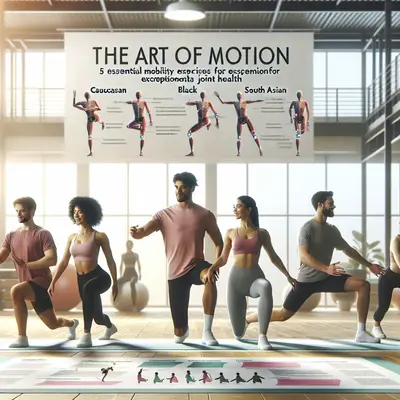
Consider a simple lunge, often used as a mobility and strength staple. A knee that tracks directly over the middle toes, a stable foot tripod (big toe, little toe, and heel grounded), and a gently braced core all help distribute load harmoniously through the hip, knee, and ankle. When alignment deteriorates—knee collapsing inward, heel lifting, spine collapsing forward—forces concentrate on vulnerable structures like the meniscus or ligaments.
The same principle applies to upper-body mobility. Shoulder circles done with the ribs flared and neck strained will not offer the same protective benefits as circles performed with a long spine, quiet ribs, and relaxed jaw. The joint might technically be moving, but the surrounding scaffolding is not supporting it.
Premium joint care is not about complexity; it is about exquisite consistency in the fundamentals. Choosing fewer, impeccably aligned mobility exercises will do more for your long-term comfort and freedom than a long list of rushed, poorly executed drills.
Mobility as a Listening Practice: Using Discomfort as Refined Feedback
Perhaps the most exclusive insight—because it cannot be outsourced—is learning to use mobility as a refined form of self-assessment. Each session becomes an opportunity to quietly “scan” the body and adjust based on what your joints reveal.
Discomfort is not always a red flag; it is often information. A hip that feels “sticky” on one side, an ankle that circles smoothly in one direction but not the other, or a shoulder that hesitates at a particular angle—these are messages. Rather than pushing past them, a sophisticated approach involves:
- Slowing the movement and reducing the range slightly
- Noticing whether the sensation eases with repetition
- Adjusting your posture, breath, or tempo to see if the quality of the movement improves
Over time, this listening practice sharpens your ability to distinguish between healthy stretching sensations and the sharper, localized discomfort that may signal irritation. It also allows you to notice trends early—like a gradually tightening hip from extended travel or an increasingly stiff neck from new work demands—so you can respond before discomfort becomes pain.
In this view, mobility is not merely therapeutic; it is diagnostic. You are, in effect, conducting a daily, personalized joint-health check with your own body as the most reliable expert witness.
Conclusion
Mobility exercises, when approached with intention and refinement, become far more than a warm-up or cool-down—they become a quiet but powerful pillar of joint longevity. By treating movement as nourishment, respecting the controlled edges of your range, integrating micro-mobility into your day, honoring alignment, and using each session as a listening practice, you create an environment in which your joints can age with grace rather than resignation.
This is the essence of a premium joint-health lifestyle: not grand, sporadic efforts, but consistent, intelligent, and elegant attention to how you move—today, and for every decade that follows.
Sources
- Harvard Health Publishing – The importance of stretching - Discusses flexibility, range of motion, and how intentional movement supports joint health
- Arthritis Foundation – Range-of-Motion Exercises - Outlines why controlled range-of-motion work protects and nourishes joints
- Mayo Clinic – Exercise and arthritis - Explains how movement, including gentle mobility, supports joint function in arthritis
- NIH / MedlinePlus – Joint Health - Provides an overview of joint structure, synovial fluid, and how movement influences joint health
- Cleveland Clinic – Benefits of stretching and mobility - Reviews the role of stretching and mobility in maintaining flexibility, reducing stiffness, and supporting daily movement
Key Takeaway
The most important thing to remember from this article is that this information can change how you think about Mobility Exercises.