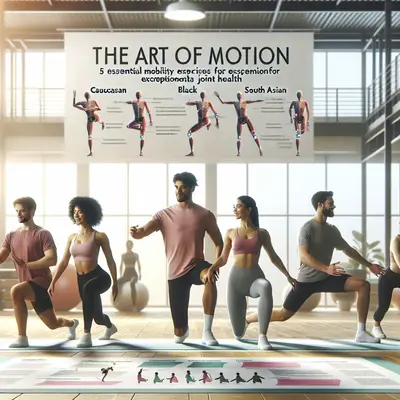
Mobility, at its most elevated, is not about stretching for the sake of flexibility. It is the conscious refinement of how your joints articulate, stabilize, and glide through space. For those who value long-term joint integrity, mobility work becomes less of a warm-up and more of a daily ritual of preservation. This is the quiet craftsmanship behind graceful movement—small, precise practices that protect cartilage, nourish synovial fluid, and maintain the subtle coordination between muscles, tendons, and ligaments.
The following approach to mobility is not about intensity; it is about discernment. These insights are designed for those who wish to move with longevity in mind—who understand that how you move today is an investment in the way you will walk, climb, and reach decades from now.
Mobility as Joint Nutrition, Not Just Flexibility
Most people equate mobility with “being limber,” but for joint-conscious individuals, mobility is more accurately understood as a form of mechanical nutrition. Each deliberate, controlled repetition acts like a pump: compressing and then releasing the joint surfaces so that synovial fluid can circulate and nourish the cartilage. Unlike muscles, cartilage has no direct blood supply; it depends on this cyclical loading and unloading to stay resilient.
This reframe changes how you move. Instead of chasing the deepest stretch, you focus on smooth, pain-free arcs of motion. Slow, circular movements of the hips, shoulders, and ankles—performed within comfortable ranges—become less about “loosening up” and more about “feeding” your joints. You learn to value consistency over drama: five minutes of controlled cars (controlled articular rotations) for your major joints each morning may be more powerful for long-term joint health than sporadic intense stretching sessions. Precision and continuity, rather than heroics, become the true markers of a premium mobility practice.
Precision Loading: The Art of Just-Enough Stress
Joints deteriorate at both extremes: too much force, too quickly—and too little stimulation, for too long. The sweet spot for longevity is what might be called precision loading: giving each joint just enough mechanical challenge to maintain strength and range without provoking inflammation or breakdown.
This means intentionally modulating three variables: range, tempo, and load. You begin within a comfortable, non-threatening range of motion, moving slowly enough to feel the entire path, and using minimal resistance. Over time, you expand the arc of motion, introduce slightly slower eccentrics (the lowering phase), and, when appropriate, add light resistance bands or small weights. This is especially protective for knees, hips, and shoulders, where controlled strength at end range helps stabilize the joint and reduce reliance on passive structures like ligaments. The sophisticated mover understands that the goal is not maximum range at any cost, but confident, strong ownership of every degree you decide to use.
Tension Mapping: Training the Nervous System, Not Just the Muscles
Mobility is not limited by tissue alone; it is heavily governed by the nervous system’s sense of safety. When the brain perceives a position as unstable or unfamiliar, it responds with protective tension. For people serious about joint health, this invites a new skill: tension mapping—the practice of noticing where your body “over-braces” and then teaching it to release that excess effort without sacrificing stability.
Practical tension mapping might look like this: you move your neck gently through its available range and observe where your shoulders, jaw, or low back subtly clamp down. Or you perform a deep hip hinge and notice if your toes claw the floor or your upper back stiffens unnecessarily. Instead of forcing more range, you pause and breathe into the area of excess tension, dialing it down slightly while keeping the joint controlled and supported. Over time, you train your system to differentiate between essential stability and habitual gripping. This refinement reduces compressive forces on the joints and allows them to move cleanly, without the “background noise” of unnecessary muscular bracing.
Joint-Specific Rituals: Curating a Personal Mobility Portfolio
Most generic mobility routines are broad and unspecific, but discerning joint care requires a more curated approach. Each person has a unique “portfolio” of joints that need closer attention—often determined by history (old injuries), profession (hours at a desk), and preferred movement (running, yoga, tennis, strength training).
Crafting a joint-specific ritual begins with an honest inventory: Which joints feel stiffest first thing in the morning? Which complain after a long workday or training session? From there, you select two to four joints to prioritize—perhaps ankles and hips for runners, wrists and thoracic spine for desk-based professionals, or shoulders and knees for strength athletes. Each chosen joint receives its own brief ritual: 2–3 targeted mobility drills practiced almost daily, not as a workout, but as upkeep. For example, ankle dorsiflexion drills before walking or running, spinal segmental cat-camel after desk work, controlled shoulder circles before upper-body training. This deliberate curation ensures your time is spent where it has the greatest protective return, transforming mobility from a random collection of stretches into a tailored joint-preservation strategy.
Bi-Directional Training: Equal Respect for Flexion and Extension
Most modern lives are biased toward flexion: bent hips, rounded shoulders, flexed necks, folded elbows. Over time, this asymmetry erodes balanced joint function. Protecting joint health requires a more bi-directional view of mobility—giving as much respect and training to extension as to flexion, and to external rotation as to internal rotation.
In practice, this might mean pairing every forward-bending pattern with a subtle, well-controlled backward one. After hours at a laptop, not just a generic chest stretch, but gentle thoracic extensions over a rolled towel; not just hip flexor stretches, but active hip extension with glute engagement. For the knees, mobility is supported by not only flexion (deep bends) but also smooth, controlled terminal extension. For shoulders, you pay as much attention to behind-the-body reaches and overhead control as you do to pushing and pulling in front of you. This bi-directional lens safeguards joint congruence—the way joint surfaces meet and glide—helping to distribute forces evenly instead of repeatedly loading the same segments and angles.
Conclusion
Mobility, when elevated beyond trend and routine, becomes a form of stewardship: a way of caring for the fine mechanics that will carry you through every decade of your life. By treating mobility as joint nutrition, practicing precision loading, mapping and refining tension, curating joint-specific rituals, and training movement in both directions, you create a subtle yet powerful protective framework around each joint.
This is not about dramatic transformation in a week. It is about a quiet, consistent refinement of how your body moves—a standard of care that aligns with those who value elegance, longevity, and control. In that sense, true mobility work is not simply exercise; it is the ongoing, deliberate choice to move in a way that your future self will thank you for.
Sources
- [Harvard Health Publishing – The healing power of movement](https://www.health.harvard.edu/pain/the-healing-power-of-movement) – Overview of how regular, controlled movement supports joints, tissues, and overall musculoskeletal health
- [Arthritis Foundation – Range-of-Motion Exercises](https://www.arthritis.org/health-wellness/healthy-living/physical-activity/stretching/what-are-range-of-motion-exercises) – Explains why gentle daily motion nourishes joints and preserves mobility, especially in arthritis
- [Hospital for Special Surgery (HSS) – Joint Protection: Keeping Your Joints Healthy](https://www.hss.edu/conditions_joint-protection.asp) – Discusses strategies for protecting joints through load management, posture, and movement choices
- [Cleveland Clinic – Joint Health: Keeping Your Joints Healthy](https://health.clevelandclinic.org/joint-health/) – Covers how controlled exercise, weight management, and balanced activity preserve joint structures
- [American Council on Exercise – Understanding Joint Mechanics and Mobility Training](https://www.acefitness.org/education-and-resources/professional/expert-articles/6684/joint-mechanics-and-mobility-training/) – Detailed explanation of joint mechanics, mobility drills, and the role of controlled loading in long-term joint function
Key Takeaway
The most important thing to remember from this article is that this information can change how you think about Mobility Exercises.