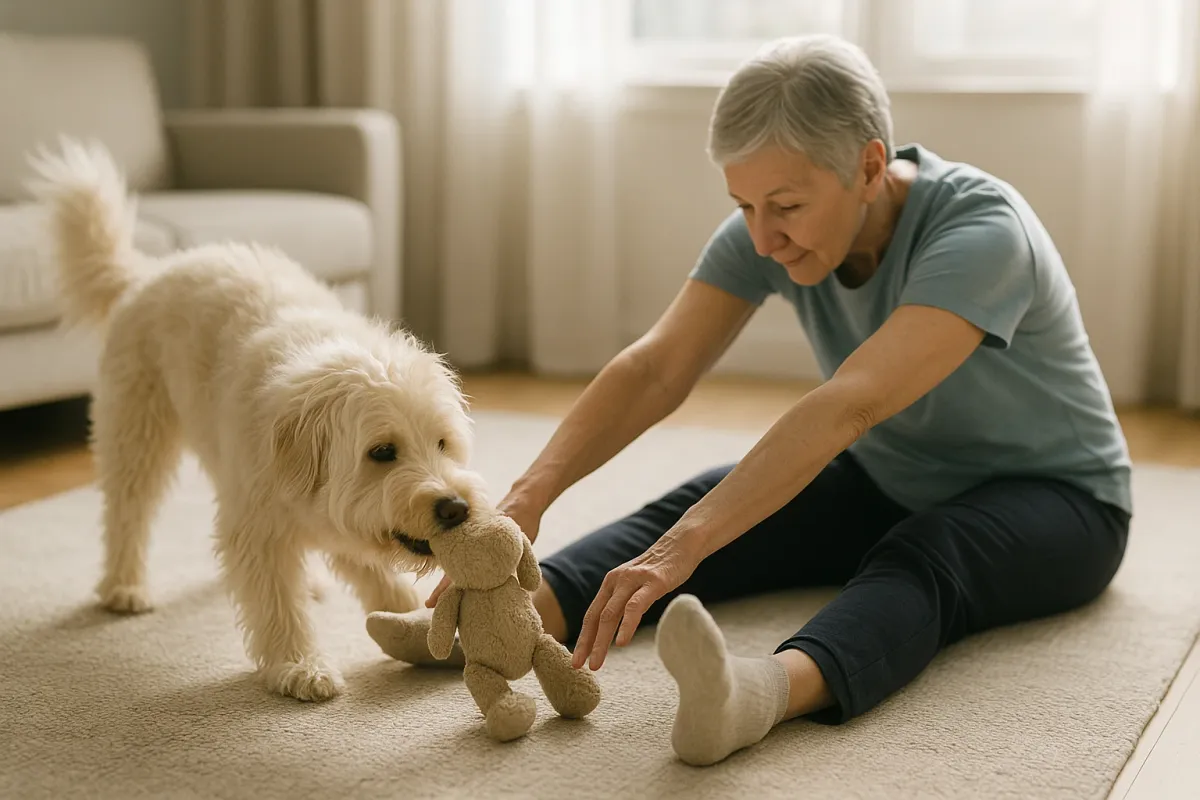
Some news stories stay with us not because they are dramatic, but because they are disarmingly gentle. The recent piece about Poi, the golden retriever who refuses to leave home without one of her plush toys, has quietly captivated social media feeds. In a timeline saturated with outrage and spectacle, this dog’s simple, unwavering ritual feels almost radical: she will not step into the world unless she feels safe, soothed, and prepared.
For anyone serious about long‑term joint health, there is a surprisingly elegant lesson hidden in Poi’s small rebellion. Mobility is not just about muscles and cartilage; it is about ritual, comfort, and the subtle cues that tell your body, “It’s safe to move.” Just as Poi’s plush toy is her portable sanctuary, you, too, can design mobility rituals that make your joints feel consistently protected and willing.
Below, you’ll find five refined, joint‑smart insights inspired by this now‑famous dog and the larger conversation her story has sparked online. Think of them as your own “plush‑level” upgrades—quiet luxuries that transform movement from a chore into a deeply reassuring daily experience.
1. Ritual Before Repetition: Why Your Joints Need A “Signal To Begin”
Poi will not cross the threshold until her plush is firmly in her mouth. That small act, repeated daily, is her nervous system’s signal that it is safe to venture outward. For your joints, a deliberate pre‑movement ritual can serve the same purpose—physically and neurologically.
Instead of dropping straight into lunges or squats, create a two‑minute “threshold sequence” that you perform before any workout or long walk. For example: gentle ankle circles, slow hip CARs (controlled articular rotations), and a short diaphragmatic breathing pattern. Over time, this precisely repeated sequence becomes a cue to your brain and connective tissues: circulation is increasing, synovial fluid is waking up, and the load about to arrive is expected, not surprising. Research in neuromotor priming and warm‑up routines consistently shows that when the body anticipates movement, joint stiffness decreases and control improves. In other words, the elegance is in the preparation, not in the performance.
2. Micro‑Security: Building A “Plush” For Your Most Vulnerable Joints
Poi’s toy is a portable anchor—a familiar object that travels with her into unpredictable environments. Your joints deserve a similar sense of continuity, especially those that have been injured or are prone to pain, such as knees, hips, or wrists.
Think of joint‑specific mobility work as a customized security blanket for vulnerable areas. For knees, this might mean a brief, daily ritual of terminal knee extensions and smooth, pain‑free flexion‑extension drills before stairs or long commutes. For wrists, especially if you type or lift often, it could be slow wrist circles, palm‑to‑fist transitions, and gentle forearm stretches before any weight‑bearing tasks. These are not random stretches; they are precise, repeatable gestures that whisper to the body: “This joint is attended to.” Over weeks and months, the tissues around that joint begin to perceive daily life as less threatening, which can quietly reduce guarding, compensate less, and restore more confident range of motion.
3. The Grace Of Constraint: Choosing Fewer, Better Mobility Drills
Poi does not have a dozen objects in her mouth—she has one. The internet fell in love with the purity of this preference: a single, cherished plush at a time. Many people undermine their mobility progress by doing the opposite, amassing an ever‑expanding list of exercises they cycle through without consistency, depth, or refinement.
A more sophisticated approach is to select a curated set of mobility drills and practice them with the kind of attention you might bring to a carefully prepared meal or a favorite piece of music. You might choose just three cornerstone movements—such as hip hinges, thoracic spine rotations, and ankle dorsiflexion drills—and layer nuance over time: slower tempos, more controlled end‑ranges, conscious breathing, and impeccable alignment. Constraint is not a limitation; it is a luxury. It allows you to notice subtle improvements in control, joint comfort, and symmetry that are impossible to detect when you are constantly chasing novelty.
4. Emotional Comfort As A Performance Enhancer
The response to Poi’s story has been as emotional as it has been amused. Comment sections are filled with people projecting their own need for comfort objects: favorite mugs, well‑worn sweaters, familiar routines. We are reminded, in real time, that humans and animals alike move best when they feel emotionally held.
There is a growing recognition in sports science and pain research that the emotional context of movement matters. High anxiety, social self‑consciousness, and internal pressure can all amplify pain perception, tighten muscles reflexively, and alter how you load your joints. A refined mobility practice acknowledges this by building emotional comfort into the session: a consistent time of day, a beautifully arranged space, supportive lighting, perhaps even a favorite playlist or scent. This is not indulgence; it is intelligent nervous‑system design. When the emotional climate softens, the body allows deeper, safer ranges of motion, and joints are less likely to be braced in rigid, protective patterns.
5. The Luxury Of Saying “Not Yet” To High Impact
Poi’s insistence on her plush is a gentle but firm boundary with the outside world: “Not yet. I’m not ready without this.” Many adults override their own version of this instinct, pushing into high‑impact activity when joints are fatigued, inflamed, or simply under‑prepared.
Cultivating discernment in your mobility practice is a quiet form of luxury—it means you have the self‑respect to delay intensity until the foundation feels right. This might look like substituting low‑impact, joint‑nourishing sequences on days when your knees or hips feel irritable: smooth cycling instead of running, controlled step‑downs instead of jump squats, floor‑based hip mobility instead of deep weighted lunges. You are not doing “less”; you are doing what is appropriate. Over time, this habit of intelligent deferral preserves cartilage, tendons, and ligaments in ways that only become truly visible—and invaluable—in your later decades.
Conclusion
As Poi and her beloved plush continue to circulate across social platforms, the story lands somewhere between charming anecdote and quiet manifesto. In a culture that often glorifies relentless effort, this small dog reminds us of something essential: movement becomes sustainable when it feels safe, familiar, and gently ritualized.
For those devoted to long‑term joint health, the invitation is clear. Design your own “plush‑level” mobility rituals—reassuring in their consistency, curated in their simplicity, and sensitive to the inner climate in which you move. When you treat each transition—from sitting to standing, from indoors to outdoors, from stiffness to ease—as worthy of preparation and care, your joints begin to trust you. And a body that trusts its own movement is, in many ways, the most luxurious place to live.
Key Takeaway
The most important thing to remember from this article is that this information can change how you think about Mobility Exercises.