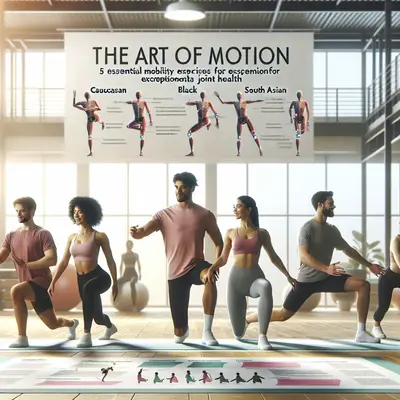
Mobility is not simply about “stretching more.” For those who care deeply about the integrity and longevity of their joints, mobility becomes a quiet art form—an intentional practice that marries precision, control, and respect for the body’s architecture. This is not the realm of flashy workouts or quick fixes; it is a disciplined, elegant commitment to moving well, so you can keep living well.
Below, we explore a refined approach to mobility exercises—one that honors the subtleties of joint health—and share five exclusive insights tailored for those who expect more than generic advice.
Rethinking Mobility: Beyond Flexibility and Strength
Most conversations around movement focus on two dimensions: flexibility and strength. Mobility, however, occupies a more sophisticated space—where joint range of motion, neuromuscular control, and tissue quality intersect.
Mobility exercises are not about forcing a deeper stretch or lifting heavier weights. Instead, they cultivate the capacity to move a joint through its full, usable range with elegant control and minimal discomfort. This involves training the nervous system, not just the muscles; educating the connective tissue, not merely lengthening it.
For joint-conscious individuals, mobility is also a form of risk management. When a joint moves poorly—stiff in some directions, lax in others—the body compensates, creating subtle wear patterns that may not be felt for years. Refined mobility work identifies and smooths these irregularities before they become structural problems.
The result: movement that feels “quiet” inside the body—no grinding, no hesitant transitions, no sense of negotiating with pain—just clean, confident motion.
Exclusive Insight #1: Treat Each Joint Like a Distinct Instrument
Most exercise plans lump the body into broad regions: “upper body,” “lower body,” “core.” A joint-focused approach requires more granularity. Each joint has a unique design and “vocabulary” of motion: hips are built for multiplanar strength; knees for guided hinge mechanics; shoulders for large arcs of rotation and reach.
A sophisticated mobility routine respects this individuality:
- Hips benefit from deep rotational work (internal and external rotation) rather than just classic hamstring and hip flexor stretches.
- Ankles require dorsiflexion (knee tracking over toes) and controlled pronation/supination to protect the knees above and the feet below.
- Shoulders thrive on controlled rotation in multiple angles, not just overhead pressing and forward reaching.
- Thoracic spine responds best to gentle, segmental rotation and extension, which then frees the shoulders and neck.
Instead of “doing some stretches after a workout,” consider building a short, deliberate sequence for each major joint complex: ankle, hip, thoracic spine, shoulder. Think of it as tuning individual instruments in an orchestra so the entire composition—your movement—sounds clear and harmonious.
Exclusive Insight #2: Micro-Loading for Mobility—Not Just for Strength
Most people associate added load (weights, bands, resistance) with strength training, not mobility. Yet, for joints, light resistance applied within a safe range of motion can be transformative. This concept—micro-loading mobility—teaches your tissues to be strong and responsive at the edges of your movement, not just at the center.
Examples include:
- Using a light dumbbell or kettlebell during hip circles to gently “anchor” the joint and enhance awareness.
- Adding a light resistance band during shoulder external rotation drills to strengthen the rotator cuff at vulnerable angles.
- Performing controlled ankle dorsiflexion with the front foot elevated and a small weight held over the knee to guide it deeper in a safe, supported way.
The elegance lies in restraint: the load is intentionally modest. The focus is on control, not effort. This approach conditions ligaments, tendons, and smaller stabilizing muscles to support the joint across its full functional range—an invaluable insurance policy against both acute injury and chronic wear.
Exclusive Insight #3: Slow Tempo as a Diagnostic Tool
Speed hides dysfunction; slowness reveals it. When you move quickly, it is easy for stronger areas to compensate for weaker ones. When you slow down—truly slow down—the body can no longer hide its shortcuts.
Mobility exercises performed at a deliberately measured tempo, often with long pauses at end ranges, function as both training and assessment:
- Controlled circles of the hips or shoulders, drawn as if you were sketching with laser precision, will instantly expose “sticky spots” or jittery transitions.
- Segmental spinal movements, rolling up and down one vertebra at a time, reveal where the spine glides and where it resists.
- Slow step-downs or lunges, paying attention to knee tracking and ankle motion, highlight subtle instability before it manifests as pain.
Instead of racing through a mobility “routine,” treat each repetition as a quiet evaluation of joint quality. Over time, you will notice the rough edges smoothing out—the shoulder that once clicked now rotates silently; the hip that felt blocked now moves with an almost surprising ease.
Exclusive Insight #4: Prioritizing Rotational Capacity as a Marker of Joint Youth
Flexion and extension (bending and straightening) get most of the attention. Rotation, however, is the unsung hero of joint vitality. Diminished rotational capacity—especially in the hips, shoulders, and thoracic spine—is a subtle but reliable marker of “aging” movement, regardless of chronological age.
Rotational mobility does three critical things for joint health:
- Distributes load more evenly across joint surfaces, reducing localized wear.
- Enhances neuromuscular coordination in complex patterns like walking, turning, and reaching.
- Preserves the “spiral” quality of human motion, which is how we naturally generate power and adapt to the environment.
Practical applications include:
- Hip rotation drills in both seated and lying positions, emphasizing internal rotation, which is often neglected yet vital for gait and squatting patterns.
- Thoracic spine rotation in half-kneeling or side-lying positions to decouple upper and lower body motion, easing strain on the lower back.
- Shoulder rotations with the arm at various angles (by the side, at 90 degrees, slightly overhead) to train control across the joint’s full navigable arc.
Cultivating rotation is less about theatrical ranges and more about clean, controlled arcs with no sharp transitions. A joint that rotates gracefully is a joint that is aging well.
Exclusive Insight #5: Pairing Mobility with Breath for Nervous System Precision
Tissues do not release tension simply because we want them to; they respond to signals from the nervous system. Breath is one of the most direct, elegant tools for sending those signals. Pairing mobility work with deliberate breathing transforms it from mechanical stretching into a full-body recalibration.
Consider these refinements:
- Exhale into end range: As you approach the edge of a stretch or controlled rotation, use a slow, extended exhale to soften muscular guarding.
- Nasal breathing during mobility drills shifts the nervous system toward a calmer, more parasympathetic state, which improves tissue receptivity.
- Breath-direction awareness: Imagine breathing “into” the side of the ribcage that feels restricted during thoracic or shoulder work, subtly encouraging expansion where it is lacking.
The goal is not to force more range with breath, but to harmonize internal signals with external motion. When breath and movement are synchronized, joints are less likely to brace defensively, and mobility gains tend to feel more natural, sustainable, and integrated.
Designing a Refined Daily Mobility Ritual
You do not need an hour a day or elaborate equipment to give your joints premium care. What you need is consistency and discernment. A simple yet elevated daily framework might look like:
- Morning (5–8 minutes):
- Gentle hip and ankle circles while standing, slow and precise.
- Thoracic rotations seated or in half-kneeling, tied to calm, measured breathing.
- Midday reset (5 minutes):
- Shoulder rotation sequence with light resistance (band or 1–3 lb weight).
- Segmental spinal flexion/extension to “untangle” desk posture.
- Evening unwind (5–10 minutes):
- Rotational hip work on the floor (90/90 positions or internal/external rotation drills).
- Ankle dorsiflexion and calf-focused mobility to counter daily loading, followed by a brief, quiet breathing practice.
The sophistication is not in complexity, but in intention: you are not just “stretching,” you are curating how each joint behaves today—and, by extension, how it will age over the coming decades.
Conclusion
Mobility training, when approached with discernment, is less about dramatic flexibility and more about quiet confidence in every step, reach, and turn. It is the subtle discipline that preserves your ability to move with poise—now and well into later life.
By treating each joint as a distinct instrument, embracing micro-loading, using tempo as a diagnostic tool, prioritizing rotation, and weaving breath into your practice, you create a mobility regimen that feels less like rehab and more like an elegant, daily ritual of physical refinement.
Your joints may never thank you out loud—but the absence of friction, hesitation, and unnecessary pain is its own form of praise.
Sources
- [Harvard Health – Why Stretching Is Important](https://www.health.harvard.edu/staying-healthy/the-importance-of-stretching) – Overview of flexibility, mobility, and their role in healthy movement and aging.
- [Mayo Clinic – Exercise and Chronic Joint Conditions](https://www.mayoclinic.org/diseases-conditions/arthritis/in-depth/arthritis/art-20047971) – Discusses how thoughtful movement and exercise support joint health and arthritis management.
- [Cleveland Clinic – Range of Motion and Joint Health](https://health.clevelandclinic.org/range-of-motion-exercises) – Explains range-of-motion exercises and their significance for maintaining joint function.
- [National Institute on Aging – Exercise and Physical Activity](https://www.nia.nih.gov/health/exercise-physical-activity) – Evidence-based guidance on integrating safe movement, including flexibility and balance work, into daily life.
- [Hospital for Special Surgery – Joint-Friendly Movement and Mobility](https://www.hss.edu/article_exercise-arthritis.asp) – Practical recommendations from a leading orthopedic institution on how to move safely while protecting joints.
Key Takeaway
The most important thing to remember from this article is that this information can change how you think about Mobility Exercises.