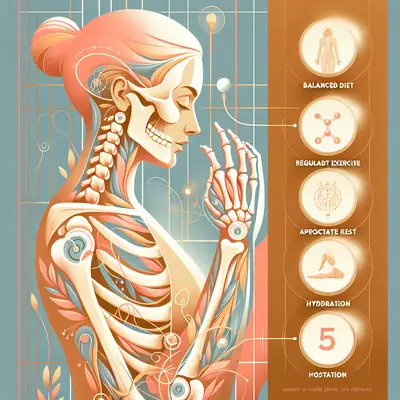
Healthy living, when viewed through the lens of joint health, is less about dramatic overhauls and more about carefully edited choices. It is the quiet luxury of being able to rise, reach, bend, and walk without negotiation. For those who prioritize the long-term elegance of their movement, joint care becomes a central design principle for daily life—not an afterthought once pain appears.
This is an invitation to cultivate a lifestyle in which every detail—from how you stand at the kitchen counter to what you pour into your evening glass—subtly protects and refines the way your body moves.
Below are five exclusive, less-obvious insights for those who consider joint health not merely a medical concern, but a standard of refined living.
1. Treat Your Cartilage Like a Luxury Fabric
Cartilage is the cashmere of your musculoskeletal system: exquisite when well cared for, unforgiving when neglected. It has no direct blood supply, which means it relies on the gentle compression and release of movement to receive nutrients from surrounding fluid. In other words, your cartilage “feeds” on subtle motion, not dramatic impact.
Long, static postures—hours seated at a desk, or standing in one rigid position—starve cartilage of this vital exchange. Short, deliberate mobility breaks act like professional laundering for a fine garment: careful, regular, and never harsh. Gentle knee bends at your desk, slow ankle circles while you wait for the kettle to boil, or a mindful walk between meetings help maintain this nutrient flow.
The refined approach is to adopt a micro-movement mindset: instead of seeking redemption in one intense workout, you architect your day so that movement is threaded throughout, preserving the integrity and “handfeel” of your joints over decades.
2. Curate Your Strength, Don’t Chase It
Strength training for joint health is not a competition in numbers; it is a curation of support. Well‑conditioned muscles act as bespoke tailoring for your joints, holding them in optimal alignment and absorbing external forces before they reach cartilage and ligaments. The key distinction for the joint‑conscious individual is this: you are training for resilience and control, not for spectacle.
Prioritize moves that integrate stability and precision over those that demand reckless power. Slow, controlled squats using a chair as a reference, elegantly executed bridges for hip support, and refined core work that teaches your spine to remain quiet and steady under load all serve as foundational investments. Load should feel like a deliberate challenge, not an assault.
Think of strength as architecture: your musculature is the discreet but essential scaffolding that allows your joints to move freely without strain. Curated, incremental progression—adding a little more resistance only once control is impeccable—protects ligaments, tendons, and cartilage while still delivering the full metabolic and functional benefits of resistance work.
3. Design Your Surroundings to Make Good Posture Effortless
Posture is often discussed as a moral virtue—“sit up straight”—rather than a design issue. Yet, for those who value longevity of movement, the more sophisticated approach is to shape environments so that elegant alignment happens automatically. Good posture, after all, is simply your joints resting in biomechanical harmony, with no structure forced to overcompensate.
Start by assessing the places where you spend the most time: desk, dining table, sofa, car. Is your screen at eye level or slightly below, or must your neck crane forward to read? Do your feet rest fully on the floor when seated, knees at or just below hip height, or are you perched and imbalanced? Even your favourite lounge chair can be re‑imagined with a small lumbar cushion to maintain the natural curve of your spine.
The refined standard is this: your surroundings should quietly insist on alignment. A laptop stand, a properly adjusted chair, and a supportive mattress are not indulgences but structural investments in how your joints age. Over time, well-designed spaces reduce cumulative micro-strain on the spine, hips, and knees—preserving effortless movement as a default, not a memory.
4. Elevate Hydration and Nutrition Into a Joint‑Wise Ritual
For a joint‑focused lifestyle, hydration and nutrition move beyond generic wellness advice and become instruments of targeted care. Synovial fluid—the “silk” between your joints—depends on adequate hydration to maintain its smooth, lubricating quality. Subtle dehydration may not always manifest as thirst but can contribute to a sense of stiffness or morning “rust.” Keeping water elegantly accessible throughout your day—a carafe on your desk, a glass at your bedside—turns hydration into a quiet ritual of preservation.
Nutritionally, consider the difference between passive and active support. A generally “healthy” diet is passive; a joint‑savvy one is intentional. Omega‑3 rich foods (like salmon, sardines, walnuts, and ground flaxseed), deeply coloured fruits and vegetables (berries, leafy greens, peppers), and extra‑virgin olive oil offer anti‑inflammatory support that can quietly reduce the biochemical “noise” around your joints. Meanwhile, moderating ultra‑processed foods, sugary beverages, and excessive alcohol intake can help limit systemic inflammation that may aggravate joint discomfort.
A premium approach does not require elaborate restrictions. Instead, it asks: Does this choice calm or provoke my joints over time? That question, asked consistently, guides you toward a personal culinary style that is both pleasurable and profoundly protective.
5. Honor Recovery as the Most Luxurious Form of Training
In a culture that glamorizes intensity, those who truly protect their joints understand that recovery is the most exclusive luxury. Cartilage, ligaments, tendons, and the small stabilizing muscles around each joint respond best to a rhythm of challenge followed by restoration. Overtraining—too much impact, too little rest—quietly erodes tissue integrity long before it causes dramatic injury.
Sleep is the most sophisticated recovery tool available, and it is both free and often neglected. High‑quality sleep supports hormonal balance, tissue repair, and pain modulation. Evening rituals that gently downshift the nervous system—dimmed lights, a consistent bedtime, screen‑light boundaries—are not simply wellness trends; they are joint‑preservation strategies.
Active recovery days—featuring low‑impact movement such as walking, tai chi, or slow, mindful stretching—allow circulation and lubrication without overloading joints. The elegant standard is to view your weekly schedule as a composition: bouts of training balanced with days of ease, so that your joints are allowed to integrate and adapt rather than endure. In this paradigm, rest is not a concession; it is where the real, sustainable gains are quietly secured.
Conclusion
A truly elevated approach to healthy living understands that joint health is the underlying architecture of every graceful gesture and independent step. When you treat cartilage like a luxury material, curate your strength with intention, shape your environment to favor alignment, refine your nutritional rituals, and honor recovery as a non‑negotiable, you are not just preserving mobility—you are protecting the quality of your future experiences.
This is the quiet luxury of movement: a life in which your joints are not a limitation, but an unobtrusive foundation for the way you work, travel, socialize, and age. In choosing to live joint‑wise now, you are investing in a future where motion remains both possible and beautifully effortless.
Sources
- [Centers for Disease Control and Prevention – Osteoarthritis](https://www.cdc.gov/arthritis/basics/osteoarthritis.htm) - Overview of osteoarthritis, risk factors, and the role of movement and weight management in joint health
- [Arthritis Foundation – The Importance of Joint-Friendly Exercise](https://www.arthritis.org/health-wellness/healthy-living/physical-activity/getting-started/joint-friendly-exercise) - Guidance on low‑impact movement and strengthening strategies that support joint protection
- [Harvard T.H. Chan School of Public Health – Fats and Inflammation](https://www.hsph.harvard.edu/nutritionsource/healthy-fats/) - Evidence on omega‑3 fats, inflammation, and their relevance to joint health
- [National Institute of Arthritis and Musculoskeletal and Skin Diseases (NIAMS) – Handout on Joint Health](https://www.niams.nih.gov/health-topics/joint-health) - Government resource explaining cartilage, synovial fluid, and protective lifestyle measures
- [Johns Hopkins Medicine – Sleep and Chronic Pain](https://www.hopkinsmedicine.org/health/wellness-and-prevention/the-connection-between-sleep-and-pain) - Discussion of the relationship between sleep quality, pain perception, and recovery
Key Takeaway
The most important thing to remember from this article is that this information can change how you think about Healthy Living.