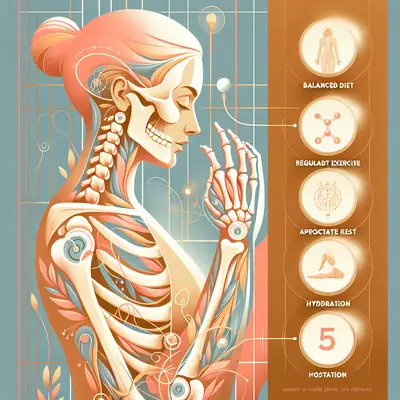
For those who treat health as an art as much as a science, joint care is not simply about avoiding pain—it is about preserving the quiet luxury of graceful movement. Healthy living, when viewed through the lens of joint longevity, becomes a deliberate design choice: what you eat, how you move, how you rest, and even how you manage your calendar subtly shapes the way your body will feel a decade from now.
This is a blueprint for those who want their joints to age as elegantly as their taste.
A Lifestyle Designed Around Cartilage, Not Just Calories
Most health advice fixates on weight, steps, or calories burned. For joint-conscious living, the more sophisticated lens is cartilage preservation and inflammation management.
Cartilage—a smooth, almost glass-like tissue—has no direct blood supply. It relies on a delicate dance of compression and release (think: walking, gentle strength work, even precise stretching) to draw in nutrients from the surrounding joint fluid. Long, motionless days at a desk, followed by sudden, aggressive workouts, create an unpredictable, often hostile environment for this tissue.
A joint-smart lifestyle favors rhythms over extremes: regular movement breaks instead of marathon sessions, strength training tailored to joint angles instead of arbitrary heavy lifting, and daily rituals that target recovery as deliberately as effort. The focus shifts from “How hard did I work?” to “How kindly did I treat my cartilage today?”
This orientation is subtle, but over years, it’s the difference between managing decline and curating longevity.
Exclusive Insight 1: Train the Stabilizers, Not Just the Stars
Most people train the muscles they can see in the mirror. Joint-conscious individuals prioritize the ones you hardly feel working—the deep stabilizers.
Around every major joint, there is a hierarchy: large, powerful “prime movers” (like the quadriceps or deltoids) and smaller stabilizing muscles (like the rotator cuff, hip abductors, and deep core musculature). When stabilizers are undertrained, the big muscles dominate, pulling joints slightly out of their ideal tracking path. The result is subtle, chronic friction that, over years, hastens wear.
Refined joint training includes:
- Slow, controlled single-leg work (such as supported single-leg deadlifts or step-downs) to train hip, knee, and ankle alignment.
- Rotational control exercises (like Pallof presses, gentle banded rotations, or controlled trunk turns) to anchor the spine and hips.
- Shoulder “prehab” rituals (external rotations, scapular control drills) before any upper body work.
The sophisticated question becomes: not “How strong am I?” but “How precisely do my joints move under load?”
Exclusive Insight 2: Your Sleep Position Is an Underrated Joint Intervention
Healthy living conversations rarely linger on the choreography of sleep. Yet your joints spend six to eight hours each night in near-fixed positions. Over months and years, this sustained posture matters.
For joint-conscious individuals:
- Side sleepers benefit from a pillow between the knees, aligning hips, knees, and ankles and reducing torsion at the lower back and sacroiliac joints.
- Back sleepers often do better with a small pillow or bolster under the knees, easing tension through the hips and lumbar spine.
- Those with shoulder sensitivity may need to avoid sleeping directly on the affected side, instead gently hugging a pillow to maintain a neutral shoulder line.
An elegant rule: your waking posture can be corrected; your sleeping posture must be curated. When your nighttime alignment supports your joints, mornings stop feeling like a daily negotiation with stiffness.
Exclusive Insight 3: Micro-Loading the Day Instead of Overloading the Workout
Common wisdom praises the singular, intense workout. Joint-wise, a more refined strategy is micro-loading—distributing mechanical stress across the full day instead of concentrating it in a single, punishing session.
This doesn’t mean doing less; it means planning better:
- Rather than one 60-minute high-impact class, consider three or four 10–20 minute segments of low- to moderate-impact movement: walking, cycling, mobility work, or gentle strengthening.
- Transition between long sitting periods with brief “mobility interludes”—ankle circles, hip hinges, shoulder rolls, or counter push-ups.
- Use environmental cues—every phone call is standing, every email block ends with 2 minutes of movement, every coffee break includes a short walk.
This rhythm respects the physiology of cartilage and tendons, which respond more favorably to frequent, moderate loading than to sporadic, intense stress. For joint longevity, volume matters, but distribution matters more.
Exclusive Insight 4: Inflammation-Savvy Dining Is About Patterns, Not Perfection
For those invested in long-term joint comfort, the plate is not just about aesthetics and flavor—it is a daily anti-inflammatory strategy. But refined joint nutrition is not a restrictive philosophy; it is pattern-based.
What repeatedly appears on your plate is more meaningful than what occasionally appears in your indulgences.
Key, joint-conscious dining principles:
- Anchor meals with color and healthy fats: leafy greens, berries, extra virgin olive oil, nuts, and seeds offer phytonutrients and omega-3s that support lower systemic inflammation.
- Prioritize high-quality protein (fish, lean meats, legumes, tofu) to support muscle mass, which in turn offloads pressure from joints and supports stability.
- Rotate your carbohydrate sources—whole grains, beans, starchy vegetables—rather than relying heavily on refined flours and sugars that can exacerbate inflammation when consumed in excess.
- Alcohol and ultra-processed foods need not be eliminated for everyone, but they are best treated like luxury items, not pantry staples.
The question transitions from “Is this food allowed?” to “Does this pattern serve the joints I want to protect ten years from now?”
Exclusive Insight 5: Stress Management as Joint Insurance
Stress is rarely framed as a joint issue, yet the physiology is clear: chronic psychological stress elevates cortisol, influences inflammation, affects sleep quality, and often alters movement habits (more sitting, more tension, less recovery). Over time, this shapes how joints feel and function.
A joint-smart approach to stress is less about dramatic life overhauls and more about integrating daily regulatory moments:
- Breathwork that lengthens the exhale (such as 4–6 seconds in, 6–8 seconds out) can downshift the nervous system and ease muscle guarding around joints.
- Brief, scheduled pauses—even 3–5 minutes between obligations—to stand, move, and breathe, prevent the body from spending an entire day in a braced, compressed posture.
- Boundaries around digital overload (no doom-scrolling before bed, screen-free periods) subtly improve both mental load and sleep quality, each directly influencing pain perception.
When stress is moderated, the body stops “holding on” so tightly. Muscles soften, movement becomes more fluid, and joints experience less constant tension. It is a form of joint care that operates from the inside out.
Weaving It Together: A Joint-Smart Standard of Living
Healthy living for joint-conscious individuals is less about dramatic reinventions and more about deliberate refinement. It is choosing stabilizer training over vanity moves, curating sleep positions as carefully as you select a mattress, embracing micro-loading across the day, shaping an anti-inflammatory food pattern instead of a restrictive diet, and treating stress regulation as a structural pillar—not an optional extra.
When these elements are quietly integrated, your joints become less a source of negotiation and more a foundation of confidence. Movement feels less like something you “manage” and more like something you own—gracefully, deliberately, and for the long term.
Sources
- [National Institute of Arthritis and Musculoskeletal and Skin Diseases (NIAMS) – Joint Health Overview](https://www.niams.nih.gov/health-topics/joint-health) – Explains how joints work, what affects them, and strategies for maintaining joint function.
- [Harvard Health Publishing – Foods that Fight Inflammation](https://www.health.harvard.edu/staying-healthy/foods-that-fight-inflammation) – Reviews evidence-based dietary patterns that help manage systemic inflammation relevant to joint health.
- [Mayo Clinic – Exercise and Arthritis](https://www.mayoclinic.org/diseases-conditions/arthritis/in-depth/arthritis/art-20047971) – Discusses how specific types of exercise protect joints and improve comfort and mobility.
- [Cleveland Clinic – Sleep Positions and Pain](https://health.clevelandclinic.org/best-sleeping-position-for-back-pain) – Details how sleep posture influences pain and musculoskeletal alignment.
- [American Psychological Association – Stress Effects on the Body](https://www.apa.org/topics/stress/body) – Outlines the physiological impact of chronic stress, including its relationship with inflammation and pain perception.
Key Takeaway
The most important thing to remember from this article is that this information can change how you think about Healthy Living.