Our joints are less like hinges and more like fine instruments—responsive, nuanced, and exquisitely sensitive to how we move through the day. Mobility work, when approached with intention, becomes less about “stretching” and more about cultivating a refined conversation between brain, muscle, and joint. This is where premium joint care lives: in the quiet, deliberate choices that preserve range, control, and comfort over decades, not days.
Below, you’ll find a sophisticated exploration of mobility training designed specifically for people who take joint health seriously—along with five exclusive insights that rarely surface in generic exercise advice.
Mobility, Reframed: From Flexibility to Functional Elegance
Most people confuse mobility with flexibility and stop there. Flexibility is passive range—how far a limb can be moved by an external force. Mobility is active range—how far you can move and control a joint. For joint longevity, that distinction is everything.
High-quality mobility training targets the joint capsule, surrounding fascia, and the neuromuscular system, not merely the superficial muscles that feel “tight.” The goal is to build usable range: the angles at which you can produce strength, absorb impact, and coordinate subtle adjustments. This is what protects cartilage, ligaments, and tendons under real-life loads—stairs, suitcases, long workdays, and changing surfaces.
A refined mobility practice also respects context: nutritional status, sleep, stress, and prior injuries all influence how tissues respond. Instead of performing random “stretches,” you curate a focused practice that aligns with your joint history, daily demands, and long-term aspirations for how you want to move at 60, 70, and beyond.
Exclusive Insight #1: Joint Mobility Is a Nervous System Skill, Not a Party Trick
Most mobility programs treat joints like static structures: pull, hold, repeat. In reality, the nervous system is quietly deciding what range feels “safe.” When it perceives instability or threat, it imposes tightness as a protective strategy.
Intelligent mobility work, therefore, is as much about building trust with your nervous system as it is about lengthening tissue. Controlled Articular Rotations (CARs), for example, are deliberate, slow circles of a single joint through its available range. Done with precision, they provide rich feedback to the brain: “This joint is controlled, stable, and strong.” Over time, the nervous system allows more range because it no longer views that range as dangerous.
This is why rushed, aggressive stretching often backfires—your body responds with more guarding. Thoughtful mobility training is quiet, intensely focused, and often surprisingly demanding. For joint-conscious individuals, the upgrade is profound: you’re not forcing range; you’re earning it by training control, coordination, and fine motor acuity around the joint.
Exclusive Insight #2: Micro-Ranges Matter More Than Extreme Stretching
Most people obsess over large, dramatic stretches: the deepest squat, the flattest forward fold. Yet the angles that most determine joint comfort are the subtle, mid-range positions where we live daily life—getting into a car, stepping off a curb, rotating to pick up a bag.
Premium joint care prioritizes these “micro-ranges”—the 10–20 degrees of motion you repeatedly enter and exit across your day. If those ranges are absent, stiff, or weak, your body will borrow motion from neighboring joints, often overloading them. For instance, limited ankle dorsiflexion (the ability to bring your shin toward your foot) forces the knee or lower back to compensate with awkward mechanics during walking or squatting.
Design your mobility sessions to refine these practical angles:
- Slight hip rotation in both directions while standing tall
- Gentle, controlled spine rotation without shifting the pelvis
- Small, precise ankle circles under light load while standing
- Elbow and wrist articulation in the ranges you actually use for typing, lifting, and carrying
By elevating micro-ranges over extreme postures, you build resilience where it actually matters, reducing wear patterns long before they become symptomatic.
Exclusive Insight #3: Load Is Not the Enemy—It’s the Language of Joint Adaptation
For many concerned about joint health, the instinct is to remove load: lighter weights, softer surfaces, more support. While this can be necessary in acute phases, a long-term pattern of “protecting” joints from all load signals the body to decondition supportive tissue. Cartilage, tendons, and ligamentous structures adapt to intelligent stress; complete avoidance accelerates fragility.
Mobility training with graded load—light weights, resistance bands, or bodyweight leverage—teaches joints to tolerate and thrive under pressure. Think of:
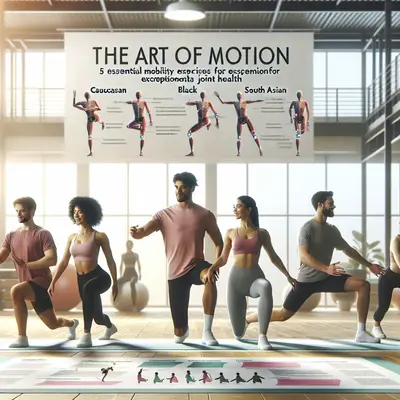
- Slow, controlled split-stance exercises that move the hip and knee through range while lightly loaded
- Isometric holds at challenging but safe joint angles (e.g., holding a deep but stable lunge)
- Gentle resistance added to rotational work at the hip or shoulder to strengthen stabilizing muscles
The key is precision, not bravado. You’re not chasing muscle burn; you’re cultivating tissue literacy: helping your joints “speak” load fluently so daily demands feel easy rather than inflammatory. For individuals already managing arthritis, this must be done with professional guidance—but the principle remains. Load, curated correctly, is medicine.
Exclusive Insight #4: Joint Alignment Begins With the Smallest Segments
Most mobility advice zooms in on the “big” joints: hips, knees, shoulders. Yet the quality of movement at these large joints is heavily influenced by smaller, often ignored segments—feet, toes, wrists, fingers, and the small stabilizing muscles of the neck.
The foot, for example, is a complex, articulating structure. Restrictions in the toes and midfoot alter how load travels up through the ankle, knee, and hip. Likewise, poor wrist mobility changes elbow and shoulder mechanics during simple tasks like pushing doors, carrying bags, or exercising.
A sophisticated mobility practice, therefore, includes:
- Toe articulation: spreading, curling, and individually mobilizing toes
- Midfoot and ankle work: gentle loading in multiple directions, not just forward and back
- Wrist CARs and light loaded carries with neutral, aligned wrists
- Upper cervical mobility and control: slow, intentional nods and rotations to restore subtle neck motion
These smaller regions act like alignment “micro-adjusters” for the entire kinetic chain. Nurturing them creates a more evenly distributed load across the skeleton, sparing major joints from disproportionate stress.
Exclusive Insight #5: Consistency at Low Volume Outperforms Occasional Intensity
The body doesn’t respond best to sporadic, heroic efforts—it thrives on regular, modest signals. Your joints are no exception. A highly curated 8–12 minutes of daily mobility has more impact on long-term joint health than a single 60-minute session every weekend performed with fatigue and impatience.
Construct a minimalist, high-quality daily sequence that:
- Touches each major joint through its available range
- Includes at least one controlled rotational drill (hips, shoulders, spine, or neck)
- Features one or two light-loaded movements that integrate multiple joints (such as a supported lunge or a light suitcase carry)
- Feels sustainable enough that you could repeat it 5–6 days a week without dread
The sophistication lies in repetition and refinement. Over weeks, the body learns your “movement baseline” and begins to stabilize around this higher standard. For people who care deeply about joint longevity, the metric is not soreness or exhaustion—it’s the quiet sense of ease during daily tasks that once felt taxing.
Integrating Mobility Into a High-Standard Lifestyle
Mobility training for joint health is not an accessory; it is a structural element of how you age. A premium approach acknowledges more than just exercises: it weaves together environment, daily habits, and subtle posture choices.
Consider adjusting workstation height to allow occasional standing hip shifts, not just static standing. Use transitions—getting out of a car, stepping off a train, rising from a chair—as opportunities for graceful, controlled movement rather than rushed, careless mechanics. Protect your highest-value movements (walking, ascending stairs, sitting to the floor and back up) by practicing them with awareness, not autopilot.
The reward for this elevated attention is compounding: improved joint comfort, preserved range, reduced injury risk, and a sense of physical authority that does not diminish with age. Mobility work, done well, is not about chasing flexibility for its own sake; it is about preserving choice—how you sit, stand, travel, and live—well into the later chapters of life.
Conclusion
Mobility, in its most refined form, is the art of moving through life with control, ease, and structural integrity. It honors the nervous system, respects micro-ranges, embraces intelligent load, begins with the smallest joints, and prioritizes consistent, thoughtful practice over episodic intensity.
For those who treat joint health as a long-term investment rather than a short-term fix, mobility work becomes a quiet daily ritual—an architectural practice that shapes how comfortably and confidently you inhabit your own body for years to come.
Sources
- Harvard Health – The importance of stretching – Overview of flexibility, mobility, and safe movement practices
- NIH – Exercise and Physical Activity: Your Everyday Guide – Evidence-based guidance on physical activity for aging and joint health
- Arthritis Foundation – Range-of-Motion Exercises – Practical information on joint-safe motion work for people with arthritis
- Cleveland Clinic – Joint Pain and Joint Disorders – Clinical perspective on joint issues and movement considerations
- Mayo Clinic – Strength training: Get stronger, leaner, healthier – Explains how appropriate loading supports musculoskeletal and joint health
Key Takeaway
The most important thing to remember from this article is that this information can change how you think about Mobility Exercises.