Our culture is in the midst of a quiet ergonomic awakening. When a $1,800 Herman Miller Aeron chair recently became the unlikely protagonist of a workplace drama—sparking office conflict, HR involvement, and even an arrest—it revealed something deeper than a dispute over luxury seating. It exposed how fiercely we cling to the belief that the right chair will save us from the consequences of long, static days.
But here’s the uncomfortable truth: even the most exquisitely engineered chair cannot out‑design what chronic stillness does to your joints.
As high‑end ergonomic furniture trends across social media and Cyber Monday sales showcase “lifetime chairs” as must‑have status symbols, those of us who care about lifelong mobility need a more elevated standard: not just what we sit on, but how often we choose not to sit at all.
Below are five refined, mobility‑first insights—designed for discerning readers who expect more than generic stretches. Think of them as a movement repertoire that quietly outperforms any chair, no matter how luxurious.
Insight 1: Your Hips Don’t Care How Expensive Your Chair Is
The Herman Miller Aeron, Steelcase Leap, and other premium chairs dominate the conversation around comfort and productivity. Yet hips, knees, and ankles respond less to mesh tension and lumbar curves and more to one simple variable: time spent in a single position.
From a joint‑health perspective, the most critical metric is not how ergonomically you sit—it’s how frequently you stop sitting. Cartilage relies on movement to “pump” synovial fluid through the joint, nourishing it much like a fine oil protects a high‑precision mechanism. Hours of uninterrupted sitting, even in a meticulously adjusted chair, slow that process to a whisper.
A sophisticated strategy reframes the workday: your chair becomes a base camp, not a permanent address. Aim to change position at least every 30–40 minutes, even if only for a single minute of intentional movement. Think of it as micro‑maintenance for your joints, the way a luxury watch receives periodic, careful winding instead of being left dormant.
Elegant practice: Pair transitions with natural work rhythms—stand and rotate your hips while a file uploads, walk during a phone call, or perform 3–5 controlled ankle circles each time you send a substantial email. Subtle, frequent motion outclasses any one‑time “perfect” posture.
Insight 2: The “Desk Unfolding” Sequence Your Spine Has Been Waiting For
When we sit, we gently fold ourselves forward—hips flexed, spine rounded, chest subtly collapsed. Over time, tissues adapt to this folded reality, and the simple act of standing tall can feel oddly foreign. Rather than snapping upright and immediately walking away from your desk, treat standing as a small, deliberate performance: an elegant unfolding.
Here is a refined, 90‑second sequence to “unfold” your spine and restore joint glide before you step away:
Decompressed Rise
Place both feet flat, hinge forward a touch, and stand up slowly as though emerging from water. Imagine your spine lengthening upwards segment by segment.
Chest Opener With Thoracic Glide
Interlace your fingers behind your back (or hold your wrist if mobility is limited). Gently draw your knuckles toward the floor, lift your sternum, and lean very slightly back without collapsing into your lower spine. Think of opening across the collarbones, not “bending” your low back.
Cervical Reset
Keeping your chest open, slide your head gently backward as if someone is guiding it from behind—no chin jutting. Hold for 5 seconds, release, and repeat three times. This counters hours of screen‑induced forward head posture.
Rotational Finish
Place one hand lightly on your opposite collarbone, and rotate your upper back (not your hips) to that side, eyes following the line of your elbow. Move fluidly, not forcefully—3–4 rotations each direction.
Performing this whenever you leave your desk—before coffee, lunch, or a meeting—signals to your spine that it is not destined to remain folded all day. Over weeks, many people notice not just better comfort but a more naturally upright, poised posture.
Insight 3: Luxury Is In The Details: Micro‑Mobility For Ankles, Knees, and Hips
Public conversation about joint health often revolves around big gestures: yoga classes, strength sessions, weekend hikes. But people with truly resilient joints tend to invest in what could be called micro‑mobility rituals—brief, precise movements that refine how joints glide in everyday life.
These practices are almost invisible to others, but exquisitely effective:
- Ankle “Figure‑Eight” Articulation
While seated or standing, gently trace a slow figure‑eight with one foot, then the other. Move from the ankle, not the knee. This challenges the joint through subtle diagonals instead of simple circles, more closely mimicking real‑world movement.
- Seated Hip Capsule Glide
Sit tall near the edge of your chair. Cross your right ankle just above your left knee. Instead of pushing your knee down, hinge your torso slightly forward, allowing your right hip to gently load. Keep the spine long. Tiny shifts—slightly left, right, and center—invite the hip capsule to move in multiple vectors. Repeat on the other side.
- Knee Nourishment Without Strain
Standing, lightly hold the back of your chair or desk. Soften one knee and perform a very small bend and straighten, as if polishing the joint surface with motion, not load. This is not a squat; it’s a controlled “glide.” Do 10–15 per leg, staying in a pain‑free, subtle range.
This kind of refined, low‑friction movement is especially valuable if you have arthritis or joint sensitivity. Rather than forcing big ranges or chasing intensity, you’re quietly cultivating smoother motion in the smallest, but most essential, places.
Insight 4: Rotation—The Neglected Dimension That Protects Your Joints
Most of our formal exercise—walking, cycling, using elliptical machines—occurs in a straight line. Yet real life demands turning, pivoting, and reaching across the body. When we neglect rotational mobility, joints can become surprisingly vulnerable to everyday twists.
Modern office life compounds this: we rotate less, stare straight ahead more, and let our ribcage and hips stiffen. Building rotation back into your day can be done with the same subtlety as sipping an espresso between meetings.
A refined rotational routine:
- Standing Pelvic Rotation (Hands‑On‑Desk Edition)
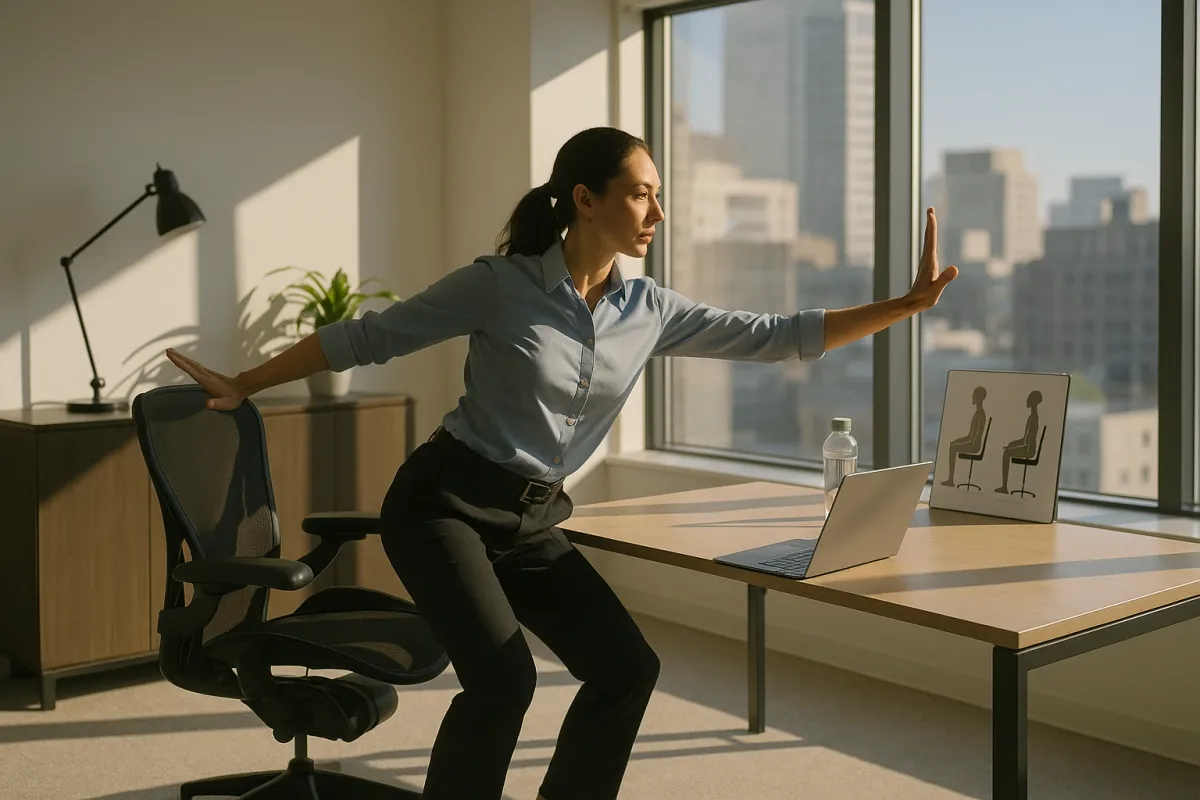
Stand lightly holding the edge of your desk. Keep one foot slightly ahead of the other. Rotate your pelvis gently to the right, then left, as if your waistband were turning on a slow, elegant swivel. Your shoulders may respond, but let the movement initiate from the hips. This trains your hips to share rotational load instead of forcing your knees or low back to absorb it.
- Seated Thoracic Spiral
Sit tall. Place your left hand on the outside of your right thigh. Gently spiral your ribcage to the right, keeping your nose in line with your sternum—no aggressive neck cranking. Take a soft breath in, lengthen your spine, and with the exhale allow one more degree of rotation. Repeat to the other side.
- Gentle Neck Rotation With “Soft Eyes”
Turning the head harshly can irritate already tense tissues. Instead, let your gaze lead: look to the right with your eyes first, then let your head follow until you meet the first hint of resistance—then stop. Breathe once here, return to center, and repeat left. The goal is not range at all costs, but smoothness and comfort.
Rotational work like this reassures your joints that turning is safe, expected, and well‑rehearsed. That pays dividends in everything from reversing your car to stepping gracefully off a train.
Insight 5: Replace “Workout Guilt” With A Curated Daily Movement Aesthetic
The Aeron chair drama showed something quietly telling: people are willing to fight, quite literally, over the promise of long‑term comfort and support. Yet many of those same individuals feel persistent guilt about not doing enough exercise—a mental burden that often leads to all‑or‑nothing behavior.
Joint health thrives not on heroics, but on consistency wrapped in elegance. Instead of aspiring to a punishing routine, curate a daily movement aesthetic that feels as considered as your wardrobe or workspace. For example:
- A 2–3 minute “wake‑up” sequence beside your bed: ankle circles, hip swings, gentle spinal side bends.
- A mid‑morning mobility interlude: the “desk unfolding” sequence, plus one rotational drill.
- A transition ritual after shutting down your laptop: 5–7 minutes of floor work—cat‑cow, a gentle child’s pose, hip bridges—before you engage with your evening.
Think of these not as workouts, but as appointments with your future joints.
This is where sophistication truly lies: in the quiet refusal to sacrifice long‑term mobility for short‑term busyness. The most luxurious thing you can give your body is not a premium chair, but a life in which your joints are asked to move well and often—with grace, subtlety, and care.
Conclusion
High‑end ergonomics may be trending, from viral office‑chair disputes to curated Cyber Monday “work‑from‑home upgrades.” But for those who see their body as a lifelong asset, the real upgrade is less about what supports you and more about how deliberately you move yourself.
Let the chair be comfortable, by all means. Just don’t mistake it for a solution.
A truly elevated approach to joint health is measured not in mesh density and armrest adjustability, but in the elegance of your daily rituals: the way you unfold from your desk, how you rotate through space, and how consistently you offer your joints micro‑moments of motion. Over time, these refined choices—not any single object—quietly author the kind of mobility that feels, in the best sense, luxuriously effortless.
Key Takeaway
The most important thing to remember from this article is that this information can change how you think about Mobility Exercises.